

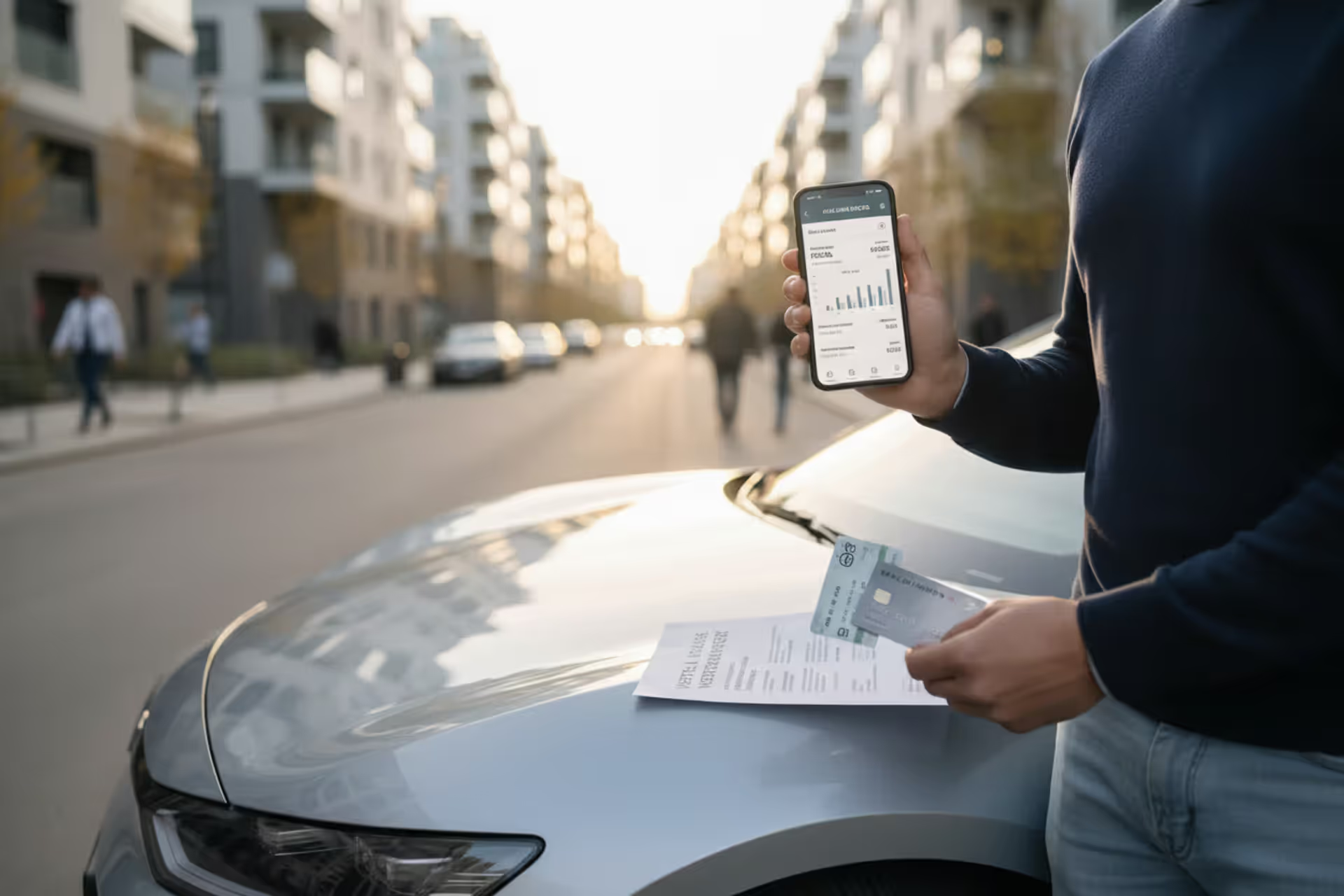
Person reviewing car loan documents next to a parked car
Should You Pay Off Car Loan Early

Content
Content
Wiping out your car loan ahead of schedule seems like an obvious win—until you crunch the numbers. Sometimes it makes perfect sense. Other times? You'd be better off putting that money literally anywhere else. What matters most: the rate you're paying, what else you could do with that cash, and where you stand with the rest of your finances.
Here's something many borrowers don't realize: car loans work on simple interest tied to your remaining balance. You're not stuck paying some fixed interest total that was baked into the loan from day one. Knock down the principal faster, and less interest piles up. Sounds great, right? But here's the catch—every dollar you throw at that car loan is a dollar that can't grow in an investment account or cover an emergency. That's the real question you need to answer.
How Early Car Loan Payoff Works
Yes, you can typically pay off a car loan whenever you want, though a handful of lenders will penalize you for it. Most auto loans calculate interest daily based on what you still owe, which is simpler than the amortization gymnastics you'll find with mortgages.
Each monthly payment hits accrued interest first, then whatever's left chips away at the principal. In the beginning, interest eats up more of your payment. Later on, you're making real progress on the actual balance. That's exactly why extra payments pack the biggest punch in the early years of your loan.
You've got options for speeding things up. Toss in one extra full payment each year, and you might shave four or five months off a five-year loan. Split your monthly amount in half and pay every two weeks instead—you'll end up making 13 full payments annually without really noticing. Or just add whatever you can spare to each payment (an extra $75 or $100 works great) and tell the lender to apply it toward principal. Windfalls like tax refunds or bonuses can go straight to a lump-sum payment.
Before you start this, dig out your loan paperwork and hunt for prepayment penalty language. Some lenders—especially those dealing with subprime borrowers—will charge you a fee for paying off the loan too quickly, often during the first year or two. These penalties might be a flat fee or a percentage of what you still owe, potentially wiping out months of interest savings. Don't rely on memory or assumptions here. Call your lender and ask point-blank whether any penalties apply to your specific loan agreement.

Author: Samantha Whitaker;
Source: ruralxchange.net
Benefits of Paying Off Your Car Loan Early
Why would you want to pay off a car loan early? The upsides are real and they hit immediately.
You'll save actual money on interest. Take a $30,000 loan at 7% stretched over 60 months. You're looking at roughly $4,762 in total interest. Pay it off a year and a half early, and you might pocket $1,200 to $1,500 depending on your approach. Higher rates and earlier extra payments mean bigger savings.
The mental relief matters more than you'd think. Deleting a $500 or $600 monthly obligation from your budget creates space to breathe. You own the car completely—no repossession risk, no hassles with a lienholder when you want to sell, no one else's name on the title.
Your monthly budget gets an immediate boost the moment you make that final payment. That former car payment can now fund your IRA, beef up emergency savings, or tackle whatever financial goal you've been putting off. Someone paying $550 monthly just freed up $6,600 a year for something better.
Your credit will see mixed effects. Erasing that monthly obligation improves your debt-to-income ratio, which helps if you're planning to apply for a mortgage soon. On the flip side, closing an installment account that's been in good standing can temporarily ding your credit mix. The impact is usually small and brief, especially when you're managing other accounts responsibly.
Full ownership gives you flexibility you didn't have before. No restrictions on modifications, simpler process for selling or trading, and complete control over the vehicle's future.

Author: Samantha Whitaker;
Source: ruralxchange.net
Drawbacks of Early Car Loan Payoff
The downsides deserve serious attention because they involve trade-offs with long-term consequences.
What you give up elsewhere is often the biggest issue. Throwing money at a 4% car loan means you can't invest those dollars in index funds that might return 8-10% annually. Over time, this compounds into real money. Pay off $10,000 in car debt at 4% and you'll save roughly $400 in interest over two years. That same $10,000 invested at 8% annual returns grows to $11,664—you're looking at more than $1,200 difference.
You're converting liquid cash into an illiquid asset. Once you pay down that loan, you can't retrieve those dollars if an emergency hits. Sure, you own more of your car, but you can't pay your rent with equity in a 2019 Honda. Converting car equity back to cash requires either selling the vehicle or taking out another loan—neither works well when you need money quickly.
Prepayment penalties can be brutal where they exist. A 2% penalty on a $20,000 remaining balance costs you $400 upfront, potentially canceling out six months or more of interest savings.
Your credit mix takes a minor hit. Scoring algorithms like seeing different types of credit—revolving accounts like credit cards plus installment loans like auto financing. Close your only installment loan while keeping only credit cards, and your score might drop 10-20 points. It recovers over time, but it's worth considering if you're about to apply for a mortgage.
That money might be desperately needed elsewhere. Credit card debt at 19% APR should absolutely take priority over a 5% car loan. Building three to six months of expenses in emergency savings beats paying off an auto loan early. Maxing out your employer's 401(k) match gives you guaranteed returns that typically beat car loan rates.
When Paying Off Your Car Loan Early Makes Sense
Should you pay off your car loan early? Yes, when these factors line up in your favor.
Your interest rate is uncomfortably high. Anything at 8% or above—which plenty of people with fair credit are paying—makes early payoff hard to beat. A 9% car loan costs you more than most conservative investments will ever earn.
You've confirmed no prepayment penalties in writing. Don't just take the word of whoever answers the customer service line. Get documentation.
You're sitting on a healthy emergency fund covering three to six months of living expenses. If you've got $15,000 in savings and want to pay off the remaining $8,000 on your car, you'll still have adequate cash reserves for the unexpected.
You've already eliminated higher-interest debt. Credit card balances at 18% APR or personal loans at 12% need to die first. The car loan can wait its turn.
Your job is stable and income is reliable. You're reducing financial flexibility here, so this matters more if you work in a volatile industry or face potential layoffs.
You're down to the last 12 months of the loan anyway. Paying it off now eliminates a monthly obligation without locking up money for years. You get the psychological win quickly.
You're buying a house soon and need to improve your debt-to-income ratio. Mortgage lenders scrutinize monthly obligations carefully, and eliminating a $500 car payment could boost your buying power by $100,000 or more depending on the loan program.

Author: Samantha Whitaker;
Source: ruralxchange.net
When You Should Keep Your Car Loan
Should you pay off your car loan early? Not always—here's when keeping the loan makes more sense financially.
You're paying under 4% interest. That's cheap money. If you locked in financing at 2.9% or 3.5%, you're paying less than typical inflation. Your money earns better returns elsewhere.
Better investment opportunities are staring you in the face. Contributions to a Roth IRA that grows tax-free for 30 years typically beats paying off a 4% car loan. Maxing out 401(k) contributions to grab your employer match offers guaranteed 50-100% returns on those matched dollars—nothing else comes close.
You're still carrying high-interest debt anywhere else. Credit cards, personal loans, or private student loans with rates above 7% deserve extra payments before your car loan sees a dime.
Your emergency fund is weak or nonexistent. Anything less than $2,000 in accessible savings means liquidity matters more than debt reduction. Build that cushion first. The peace of mind beats modest interest savings every time.
You deduct car loan interest as a business expense. Self-employed people who use vehicles for business might benefit from keeping the loan and writing off the interest portion of payments. Run this by a tax professional to see if it applies to your situation.
You're underwater on the loan, owing more than the car's current value. While this doesn't change the interest-saving math, it might influence whether you want to maintain liquidity in case the vehicle needs unexpected replacement.
Major expenses are coming like a wedding, home renovation, or college tuition. You'll need cash reserves for these, so keeping your car loan preserves flexibility.
How to Pay Off Your Car Loan Early
You can't evaluate car loan payoff in a vacuum.I always tell clients to zoom out and look at their entire financial picture. Someone paying 8% on a car loan but sitting on just $1,000 in savings is solving the wrong problem. Build that emergency fund first. Now, if you're financially stable with solid reserves and you're facing a 7-9% rate, early payoff becomes one of the better risk-free returns you'll find anywhere. It's all about sequence—tackle your financial priorities in the right order, not just the one that feels most urgent.
— Marcus Chen
Ready to accelerate payoff? Here's your step-by-step approach to maximize savings and avoid costly mistakes.
Pull out your loan agreement and read it carefully. Hunt for any section mentioning prepayment—you might see it labeled "prepayment privilege" or "early payoff terms." Note anything about penalties, fees, or restrictions. If the language is confusing, request written clarification from your lender.
Confirm prepayment penalty status by calling your lender directly. Ask this exact question: "If I pay off my loan today, will I face any fees or penalties?" Document the representative's name and conversation date. Some lenders waive penalties after the first 12-24 months, so timing matters.
Pick your payment strategy based on cash flow and personal discipline. Biweekly payments work beautifully if you're paid every two weeks—just automate half your car payment with each paycheck. Extra principal payments offer flexibility; add whatever you can afford each month, specifying it goes toward principal, not future payments. Lump-sum payments make sense for tax refunds, bonuses, or inheritance money.
Call your lender first before sending extra money. Some require specific instructions to ensure additional payments hit principal rather than prepaying future interest. Ask whether you need to submit payments through a specific channel or include written instructions.
Set up automation to maintain consistency without thinking about it. Schedule automatic transfers from checking timed with your paycheck deposits. Even an extra $75 per payment makes measurable impact over time.
Monitor your progress monthly by checking your loan balance. Most lenders offer online portals showing remaining principal and updated payoff dates. Watching the balance drop faster than the original schedule provides motivation to keep going.

Author: Samantha Whitaker;
Source: ruralxchange.net
Verify everything when you make your final payment. Request a payoff statement confirming zero balance and lien release. Follow up to confirm your state DMV receives the lien release—you'll need this to get a clear title.
Mistakes to avoid: Never assume extra payments automatically hit principal; always specify. Never drain your emergency fund to eliminate the loan. Never ignore higher-interest debt just to focus on the car loan. Never forget to adjust your insurance after owning the vehicle outright—different coverage options might now make sense.
Pros and Cons of Paying Off a Car Loan Early
| Advantages | Disadvantages |
| Keep hundreds to thousands you'd otherwise pay in interest | Sacrifice investment opportunities with potentially better returns |
| Delete monthly payment obligation from your budget | Convert liquid cash into illiquid vehicle equity |
| Own the vehicle completely without repossession risk | Face potential prepayment penalties from some lenders |
| Strengthen debt-to-income ratio for future borrowing | Reduce credit mix diversity temporarily |
| Redirect monthly cash flow toward other financial goals | Lose tax deductions if you use the vehicle for business |
| Experience the psychological relief of debt elimination | Face opportunity cost if other debt charges higher interest |
| Simplify the process of selling or trading the vehicle | Reduce flexibility if unexpected major expenses arise |
Frequently Asked Questions About Early Car Loan Payoff
Paying off your car loan ahead of schedule delivers guaranteed interest savings and genuine psychological benefits, but it's definitely not the right move for everyone. Your decision needs to rest on your specific interest rate, emergency fund status, alternative investment opportunities, and what other financial obligations you're juggling.
Calculate the actual numbers before you act. Figure out exactly how much interest you'll save against what those same dollars could potentially earn elsewhere. Facing a 7% car loan but have an empty emergency fund? Build savings first. Paying 3% while you're not maxing out retirement contributions? Keep the loan and invest the difference instead.
The mathematically perfect choice isn't always the psychologically perfect one. Some people genuinely sleep better without any debt, even at low interest rates. Others prefer maintaining flexibility and maximizing long-term investment returns. Both approaches work fine—what matters is making an informed decision aligned with your complete financial picture rather than blindly following generic advice.
Before you send any extra payments, verify you won't face penalties, confirm you're adequately covered for emergencies, and make certain you're not neglecting higher-priority financial goals. If those boxes are checked and your interest rate justifies action, accelerating your car loan payoff saves real money and simplifies your financial life.
Related Stories

Read more

Read more



The content on this website is provided for informational and educational purposes only. It offers general guidance on topics related to car loans, auto refinancing, interest rates, credit scores, loan terms, and vehicle financing options. The information presented should not be considered financial, legal, or professional advice.
Auto loan terms, interest rates, approval requirements, and refinancing options may vary depending on the lender, credit profile, and individual circumstances.
While we aim to keep the information accurate and up to date, we make no guarantees regarding its completeness or reliability. Visitors should review official loan documents and consult with qualified financial professionals before making decisions related to auto loans or refinancing.