

Person reviewing car loan payments next to a parked car
How to Pay Off My Car Loan Faster Without Breaking the Bank

Want to eliminate your car loan ahead of schedule without turning your budget upside down? The right tactics can cut years from your payment timeline and keep serious money out of your lender's pocket.
According to 2026 lending data, Americans finance an average of $28,000 when buying vehicles, with payment plans stretching past five and a half years. Add interest rates pushing past 6%, and you're watching hundreds of dollars vanish monthly into interest charges. But here's what most borrowers don't realize: loan documents establish the longest timeframe you'll pay—not the only option available. Smart adjustments to how you handle payments can move up your debt-free date significantly.
Why Paying Off Your Car Loan Early Makes Financial Sense
Every extra dollar you throw at your balance stops creating new interest charges. Take a $25,000 loan at 7% over five years as an example. Pay only the minimum each month, and you'll hand over about $3,761 in interest by the final payment. Knock out that same debt a year early? You keep roughly $700 that would have gone to the lender.
But the financial benefits tell only part of the story. Finishing your loan early means getting the title in your name sooner. Without a lienholder involved, you control decisions about insurance coverage levels (though you'll want to think carefully before dropping protection), and that monthly bill stops blocking other money goals. Your debt-to-income ratio improves dramatically—something mortgage lenders and other creditors care about when reviewing applications.
What about your credit score? Closing an installment account might cause a small dip temporarily since you've reduced your credit mix. However, this minor drop gets balanced by lower overall debt and a solid track record of on-time payments. More valuable than a few score points: you're developing disciplined debt habits that strengthen every future financial move you make.
Then there's the mental relief. Erasing a $450 monthly obligation opens up choices. You're not tied to a depreciating asset anymore, giving you flexibility to change jobs, relocate, or handle income gaps without that payment deadline creating constant stress.

Author: Brandon Ellsworth;
Source: ruralxchange.net
Make Extra Payments Toward Your Principal
Attacking the principal directly gives you the fastest way to pay off car loan debt. Standard payment structures hit interest charges first, then whatever remains reduces your principal. When you send extra money specifically designated for principal, you shrink the balance that generates interest—creating a snowball effect that accelerates payoff.
How the Bi-Weekly Payment Method Works
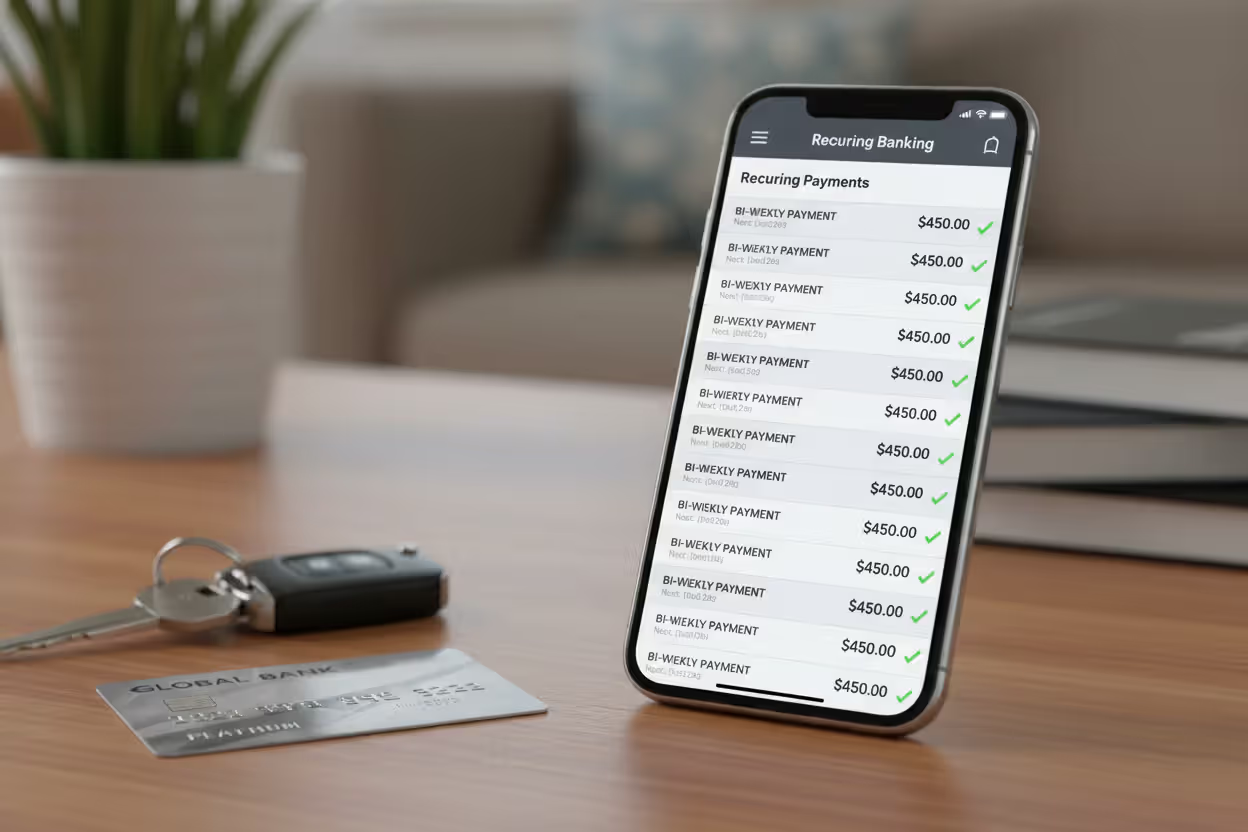
Here's the concept: divide your monthly payment in half and submit it every two weeks. Since there are 52 weeks in a year, you make 26 half-payments—which equals 13 full payments instead of 12.
Say your monthly obligation is $400. Send $200 every two weeks instead. Over the year, you contribute $5,200 rather than $4,800. Keep this pattern going through a five-year loan, and you'll typically finish six to eight months early while saving several hundred in interest.
One major warning: make absolutely sure your lender handles bi-weekly payments properly. Some servicers hold your first payment until the second one shows up, then process both as a single monthly payment—which defeats your entire strategy. Call your servicer and ask exactly how they process bi-weekly submissions. If they can't accommodate this approach, set up automatic transfers to a separate account, then manually submit full monthly payments while applying your accumulated extra amount once or twice per year.
Author: Brandon Ellsworth;
Source: ruralxchange.net
Rounding Up Your Monthly Payment
Your required payment is $387? Send $400 or $425 instead. This method requires almost no lifestyle change for most people—we're talking about the cost of two coffee shop trips—but it chips away at principal every single month.
Look at the numbers on a $20,000 loan at 6.5% over five years with a $391 minimum payment. Bump each payment to $425, and you'll save around $600 in interest while cutting seven months off your loan. Push it to $450 monthly, and you're approaching a full year in savings.
The psychological benefit here is consistency. You're not hunting for extra cash every month; you've just reset your baseline payment amount in your budget.
Applying Windfalls and Bonuses
Tax refunds, work bonuses, inheritance money, garage sale proceeds—every lump sum gives you a chance for major principal reduction. A $2,000 tax refund applied against a $15,000 balance can save you $300 to $500 in future interest while removing months from your timeline.
The quickest way to pay off car loan obligations involves treating unexpected money as debt-elimination fuel rather than spending opportunities. You don't have to throw the entire windfall at your loan if other priorities compete for attention, but directing even half of bonus income creates meaningful acceleration.
Always mark extra submissions as "principal only" when you send money. Without clear instructions, some lenders will apply unspecified payments to future interest or credit them against upcoming scheduled payments—neither approach reduces your balance or creates savings.
Refinance to a Lower Interest Rate or Shorter Term

Author: Brandon Ellsworth;
Source: ruralxchange.net
Refinancing swaps your existing loan for new financing, ideally at a lower rate or shorter term. When your credit has improved since the original purchase, or market rates have dropped, refinancing often becomes one of the best ways to pay off a car loan faster.
Picture a borrower with $30,000 at 8% over 72 months, paying $525 monthly and surrendering $7,800 to interest. Refinance to 5% over 48 months, and monthly payments jump to $690, but total interest drops to $3,120—saving $4,680. The loan wraps up in four years instead of six.
Refinancing makes sense when:
- Your credit score has jumped 50 or more points since original financing
- Current market rates sit at least one percentage point below your existing rate
- You have at least two years left on your current loan
- Your vehicle's value exceeds what you owe (you're not underwater)
Most lenders won't refinance amounts below $7,500 or vehicles older than 10 years. Expect some fees—application costs, title transfer expenses, and possibly prepayment penalties on your original loan. Make certain your interest savings exceed these costs.
Shorter terms require higher monthly payments, making this option work best after getting a raise, paying off other debt, or successfully cutting expenses. The upside is forced commitment: you're contractually obligated to larger monthly payments, eliminating the temptation to skip voluntary extra contributions.
Credit unions often beat traditional banks by a full percentage point on refinance rates. Online lenders offer alternatives, though you should verify their reputation and review fee disclosures carefully.
Do not save what is left after spending, but spend what is left after saving
— Warren Buffett
Cut Expenses and Redirect Savings to Your Loan
A thorough budget review reveals spending you've stopped noticing. The goal isn't harsh deprivation—it's moving dollars from low-value spending toward high-impact debt reduction.
Start with subscription services. Most households carry eight to twelve recurring charges: streaming services, gym memberships, app subscriptions, meal kit deliveries. Cut or pause anything you haven't used in 30 days. Even $60 freed up monthly becomes $720 annually—enough for serious principal reduction.
Call your auto insurance company and request discounts. Ask about policy bundling, safe driver discounts, or prepayment options. Shop competitor rates twice a year. Switching carriers or adjusting coverage can save $300 to $600 yearly without sacrificing protection.
Planning meals strategically cuts grocery bills 20% to 30% for typical households. A $150 weekly shopping habit drops to $105 through planning and reducing waste. That creates $180 monthly for loan acceleration.
Extra income doesn't require a traditional second job. Freelance work, selling unused items, or monetizing skills you already have can generate $200 to $500 additional monthly. A graphic designer might take weekend branding gigs; mechanically inclined people could offer basic repair services. Put 100% of side income toward your car debt for dramatic results.
The best way to pay off car loan balances through expense cuts involves automation. When you cancel a $15 subscription, immediately set up a $15 automatic transfer to your loan. The money never hits your checking account as spendable cash, removing temptation, while your balance drops faster.

Author: Brandon Ellsworth;
Source: ruralxchange.net
Avoid These Common Car Loan Payoff Mistakes
Some loan contracts contain prepayment penalties—fees charged when you pay off the balance early. These provisions help lenders recover lost interest income. Before ramping up payments, check your loan paperwork or call your servicer to find out if penalties apply. When they exist, calculate whether your interest savings still beat the penalty charge. Often they do—but not always.
Depleting your emergency fund to aggressively pay down your car loan leaves you exposed. When surprise expenses hit—medical bills, home repairs, job loss—without cash reserves, you'll probably turn to high-interest credit cards, wiping out your debt reduction gains. Build at least $1,000 to $2,000 in accessible savings before throwing every available dollar at car debt. Once that cushion exists, split surplus funds between building reserves and paying down debt until you reach three to six months of expenses saved.
Focusing on low-interest debt payoff ignores basic math. When your car loan charges 3.5% while credit cards accumulate 22% interest, the numbers say tackle cards first. The exception: if eliminating the car payment gives you psychological momentum that keeps your entire debt reduction effort going, the emotional value might justify mathematical inefficiency.
Not verifying that extra payments hit principal represents an expensive mistake. Some lenders redirect additional payments to future interest or advance next month's due date without specific instructions. Log into your account after each extra payment to confirm principal reduction matches what you sent. If you spot discrepancies, contact the servicer immediately for correction.
Should You Pay Off Your Car Loan or Invest Instead?
This choice depends on comparing your interest rate against risk tolerance. When car debt charges 8% while conservative investment accounts might return 7% to 9% annually, prioritizing loan elimination makes mathematical sense. You're locking in a guaranteed 8% "return" by avoiding interest expense, with zero market risk.
When your loan charges 3%, and your employer offers 401(k) matching, investing wins. A 50% match delivers instant 50% returns—far exceeding your loan cost. Max out matching contributions first, then decide whether loan acceleration or continued investing deserves priority.
Age matters too. Borrowers in their 20s or 30s with decades until retirement often benefit more from compound growth in tax-advantaged accounts despite moderate car loan interest. People in their 50s or 60s might prefer the certainty of debt elimination over market exposure.
Personal comfort with risk drives individual choices. Investment accounts fluctuate; loan payoff guarantees savings. When market swings keep you awake at night, the peace of mind from owning your car outright might beat several percentage points of potential investment gains.
A balanced approach: contribute enough to retirement accounts to capture full employer matching, maintain emergency savings, then put remaining surplus toward car debt. You're building long-term wealth while simultaneously reducing debt burdens.
Frequently Asked Questions About Paying Off Car Loans Faster
Speeding up your car loan payoff doesn't demand major lifestyle changes or financial windfalls. Results come from consistent, strategic moves: raising payment amounts, directing bonuses to principal, refinancing when conditions favor it, and cutting spending that doesn't improve your life.
These tactics work individually, but combining several multiplies their impact. Refinance to better rates, switch to bi-weekly payments, and redirect $75 from canceled subscriptions toward your loan each month. A six-year obligation suddenly becomes a four-year commitment, while thousands in saved interest flows to your priorities instead of your lender's bottom line.
Start with one approach this week. Log into your loan account, check your current payoff balance, and make one extra principal payment—even if it's only $25. That small action builds momentum, and momentum changes how you handle debt. Soon you're not just paying off a car loan faster—you're creating financial habits that benefit you for years to come.
Related Stories

Read more

Read more




The content on this website is provided for informational and educational purposes only. It offers general guidance on topics related to car loans, auto refinancing, interest rates, credit scores, loan terms, and vehicle financing options. The information presented should not be considered financial, legal, or professional advice.
Auto loan terms, interest rates, approval requirements, and refinancing options may vary depending on the lender, credit profile, and individual circumstances.
While we aim to keep the information accurate and up to date, we make no guarantees regarding its completeness or reliability. Visitors should review official loan documents and consult with qualified financial professionals before making decisions related to auto loans or refinancing.