

Person reviewing car financing paperwork next to a pickup truck at a dealership
Balloon Car Loan Guide

Content
Content
Picture this: you're financing a $40,000 truck, but your monthly bill looks more like you bought a $25,000 sedan. That's the basic promise of balloon financing—drastically smaller payments right up until the final month, when suddenly you owe $15,000 in one shot. It's a financing strategy that either fits your situation perfectly or becomes a financial trap, and the difference usually becomes clear about six months before that big payment hits.
What Is a Balloon Car Loan?
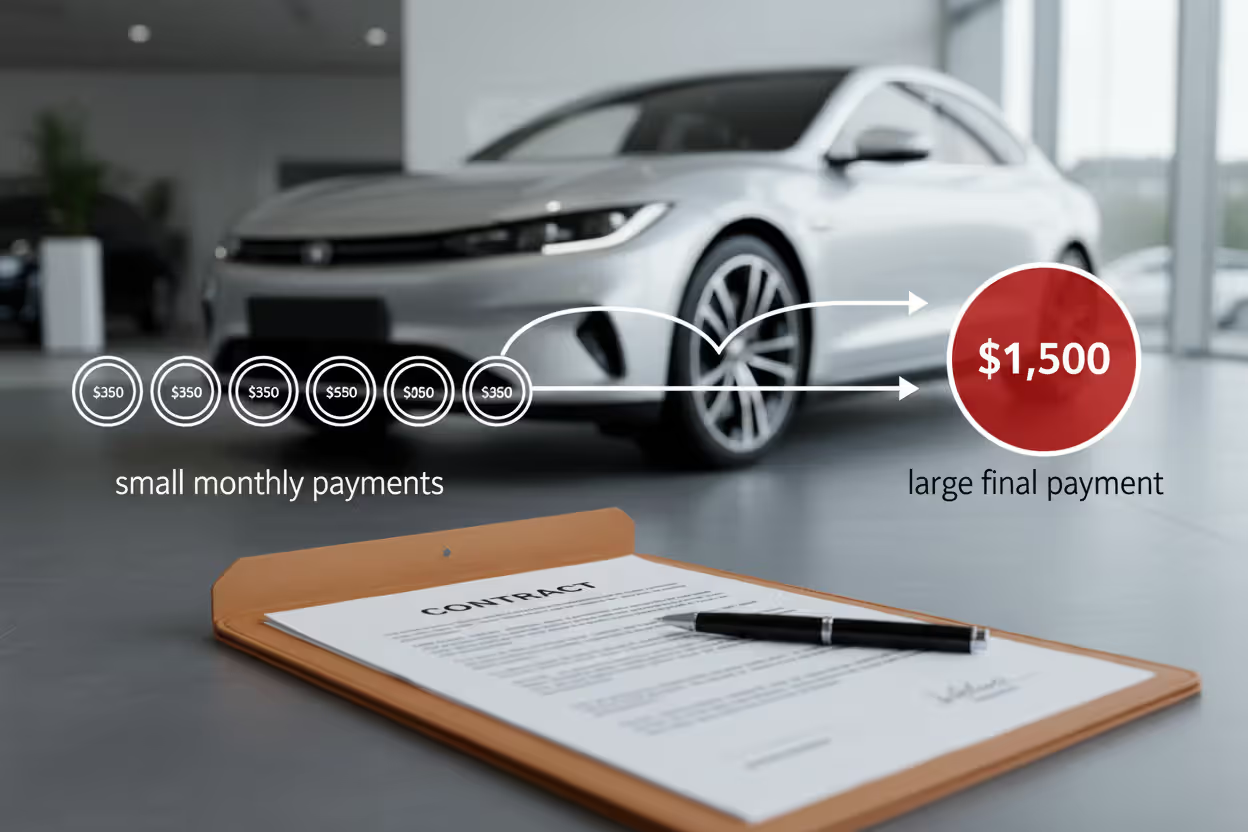
Here's how balloon financing actually works in practice. You're buying a vehicle—let's say that $40,000 truck—and instead of spreading the entire amount across 60 equal payments, the lender says "pay us smaller amounts for 59 months, then one massive payment for the last installment." That final chunk? Usually somewhere between a quarter and half of what you originally borrowed.
Author: Brandon Ellsworth;
Source: ruralxchange.net
Most of these loans run anywhere from three to six years. Your regular payments barely touch the principal—they're mostly covering the interest charges stacking up each month. Meanwhile, that deferred amount sits there waiting. Depending on the vehicle's sticker price and your terms, you might face a final bill anywhere from $8,000 to $25,000 or more.
Banks calculate that final number using something called residual value—basically what they predict the vehicle will be worth when your loan wraps up. Sound familiar? That's because it's the same math leasing companies use. The difference here: you actually own the vehicle from day one. The title's in your name (with the lender's lien, sure), you can bolt on whatever aftermarket parts you want, and nobody's tracking your odometer or charging you for door dings.
Not every lender offers this option. Your neighborhood credit union might, some national banks do, and dealerships occasionally push them hard—especially when you're eyeing something pricier than your monthly budget can typically handle. That's actually the whole sales pitch: "Can't swing $700 a month? How about $425 instead?" They're not wrong about the monthly savings. But they're also not mentioning that you'd better have a solid plan for coming up with a small fortune when the loan ends.
How Balloon Payment Car Loans Work
The payment structure splits your debt into two wildly different pieces. Take that $35,000 vehicle financed at 7.5% over five years with a 40% balloon ($14,000 sitting at the end). Your monthly payment might land around $425. Compare that to $700 monthly if you'd gone traditional, and yeah, the appeal makes sense—at first.
But here's what's actually happening with each payment. Most of your $425 is covering that month's interest charges. Whatever's left chips away at the principal, slowly. By the halfway point—month 30—you've handed over $12,750 total. Feels like progress, right? Except after the lender takes their interest cut, you've knocked maybe $4,000 off the principal. And that $14,000 balloon? Still sitting there, exactly as large as when you started.
Example Payment Scenario
Let's run real numbers on a $40,000 SUV with typical terms:
- Sticker price: $40,000
- You put down: $3,000
- Financing: $37,000
- Interest rate: 8.25%
- Length: 60 months
- Balloon sitting at the end: $16,000 (about 43% of what you borrowed)
Your monthly payment works out to roughly $465. Over five years, you'll pay $27,900 in those monthly chunks, plus the $16,000 balloon at the end. Total cost: $43,900, which means you paid $6,900 in interest. Now, a traditional 60-month loan on that same $37,000 would run you about $755 monthly with around $8,300 in total interest—but no lump sum waiting to ambush you at the end.
When that final payment comes due, you've got three moves: pay the whole balloon with cash you've saved up, refinance that amount into a fresh loan, or sell the vehicle and use whatever you get to cover what you owe. Each option creates its own financial situation, and none of them are guaranteed to work out smoothly.

Author: Brandon Ellsworth;
Source: ruralxchange.net
Pros and Cons of a Car Loan with Balloon Payment
The upside:
Those reduced monthly payments create breathing room in your budget—we're talking $200 to $400 extra every month that you're not sending to your auto lender. Some people use that cash to knock out credit card balances faster. Others invest it. Either way, it's real money staying in your pocket for 59 months.
The math also lets you drive something nicer. A $50,000 truck suddenly costs about the same per month as a $32,000 sedan financed traditionally. If you've been eyeing vehicles outside your usual price range, balloon financing makes them accessible.
Business owners sometimes love this structure because it preserves operating cash. Maybe you run a contracting company with seasonal revenue, or you're expecting a major client payment in year five. The lower monthly hit helps you manage cash flow while you wait for that bigger money to arrive.
Unlike leasing, you own it. Modification it however you want—lift kit, custom exhaust, wrapped in chrome, whatever. Drive 40,000 miles a year if that's your life. No lease inspector will ding you for worn floor mats when this ends.
The downside:
You're building equity at a snail's pace because interest eats most of your early payments. Need to sell in year three? You'll probably owe more than the vehicle's worth—sometimes thousands more. That's negative equity, and you'll need cash from somewhere to cover the gap.
That balloon payment creates a financial deadline you can't ignore. Life happens in five years. People lose jobs, businesses struggle, medical bills pile up, kids need college money. That $18,000 you owe in month 60 doesn't care about your circumstances—it's still due.
Refinancing sounds easy until you actually try it. The lender will check your credit again, verify your current income, and appraise the vehicle's value. If your credit score dropped 50 points, or the vehicle depreciated faster than predicted, or rates went up two points since you started—suddenly refinancing becomes expensive or impossible.

Author: Brandon Ellsworth;
Source: ruralxchange.net
Total interest often ends up higher than traditional financing once you factor in refinancing fees and potentially higher rates on that second loan. The monthly savings you enjoyed for five years can evaporate pretty fast when you're refinancing at 11% instead of your original 7.5%.
Basically, you're gambling on your future. Most borrowers genuinely believe they'll be in better financial shape in five years. Many aren't.
| Feature | Balloon Loan | Traditional Loan |
| Monthly payment amount | Typically $300–$500 less | Higher but steady and predictable |
| Total interest paid | Usually higher once you refinance | Lower overall cost |
| Equity buildup | Crawls along slowly until balloon's paid | Builds consistently throughout |
| End-of-term obligation | One massive payment ($8,000–$25,000+) | Nothing—vehicle's yours |
| Best for | Need short-term affordability or expecting windfall | Want long-term ownership and clear budget |
| Risk level | High—your future situation matters | Low—obligations are transparent upfront |
Who Should Consider a Balloon Loan Car?
This financing type works for specific people in specific situations—not as some universal solution when monthly payments feel too high.
Good candidates include folks who genuinely have money arriving later. Real examples: you're inheriting assets through a trust that distributes in five years. Your company offers vested stock options that mature in 2029. You sold a business with structured payments arriving annually. You're receiving settlement money on a schedule. These are documented, reliable windfalls timed roughly when your balloon comes due.
Self-employed people with lumpy income sometimes make this work. Real estate agents in seasonal markets might earn 60% of their annual income between March and August. Having lower payments during the slow winter months helps, with plans to knock out the balloon from spring commission checks. But this requires discipline—actually saving that money instead of spending it.
Corporate executives with contractually guaranteed bonuses can time balloon payments around annual compensation events. Just know this assumes your job's stable and your company performs. The last few economic hiccups proved those assumptions don't always hold.
People who should run away from balloon loans: anyone using the lower payment to justify buying more car than they can actually afford. If $700 monthly feels impossible, $425 plus a future $16,000 bomb isn't a solution—it's just delayed disaster.
First-time buyers rarely understand how this works until it's too late. Without experience managing vehicle depreciation and auto loan mechanics, that final payment becomes a nasty surprise.
Anyone with unstable employment, inconsistent income without serious cash reserves, or existing debt problems should stick with traditional financing. The balloon payment doesn't negotiate or care about your situation when it arrives.
Alternatives to Car Loans with Balloon Payments
Traditional auto loans remain the straightforward path. Fixed payments every month, equity building steadily, and when it's over, the car's yours with no lingering obligations. Current rates for buyers with solid credit run roughly 6.5% to 9.5% depending on loan length and which lender you're using. You'll pay more monthly, but you're trading that for certainty and lower total cost.
Leasing gives you lower payments than both balloon and traditional financing, with zero purchase obligation when it ends. You're basically renting the vehicle's depreciation over two or three years. Works great if you like driving new vehicles under warranty and don't mind perpetual payments. Just know about mileage caps (usually 10,000 to 15,000 miles yearly) and potential charges for excessive wear. When your lease ends, you can return it and walk away, buy it at the predetermined residual value, or lease something else.
Personal loans from banks or credit unions give you cash to buy a vehicle without using the car as collateral. This approach requires strong credit and usually costs 2% to 4% more in interest than secured auto loans. The vehicle's yours immediately with no lien, meaning you can sell whenever you want without asking a lender's permission.
Manufacturer financing through captive lenders—Ford Credit, Toyota Financial, Honda Finance, etc.—sometimes runs promotional rates as low as 0% to 2.9% APR for well-qualified buyers on specific models. These deals typically require excellent credit (720+) and might exclude certain rebates or incentives. When you can snag these rates, they beat balloon loans economically by miles.
Balloon financing only makes actual sense when none of these alternatives fit your specific situation AND you've got a concrete, realistic plan for that final payment.
How to Get Out of a Car Loan Balloon Payment
That balloon due date is approaching and you don't have the cash. Here's what you can actually do—none of these options are perfect, but some are definitely better than others.
Refinancing turns the balloon into a new loan with monthly payments. Start with your current lender—many offer balloon refinancing programs with streamlined approval since they already know you. You'll need provable income, decent credit (usually 620 minimum), and the vehicle's current value needs to support the loan amount. If it depreciated hard, you might need to refinance more than it's worth, which requires gap coverage or cash down to bridge the difference.

Author: Brandon Ellsworth;
Source: ruralxchange.net
Refinancing isn't free. Expect application fees, title transfer charges, and potentially higher interest rates than your original loan carried. A $15,000 balloon refinanced at 10.5% over 48 months costs roughly $385 monthly and adds $3,480 in interest—money you wouldn't spend if you could just pay the balloon with savings.
Selling the vehicle works when its market value meets or beats the balloon amount. Check your car's worth using Kelley Blue Book, Edmunds, or browse recent comparable sales on Autotrader. If it's worth $18,000 and your balloon's $14,000, you'll pocket $4,000 (minus selling expenses) and can buy something cheaper with cash or lighter financing.
If the vehicle's worth less than the balloon—common with vehicles that depreciated faster than predicted—you'll need cash to cover the shortfall. A $12,000 market value against a $16,000 balloon means coming up with $4,000 out of pocket just to close the loan.
Trading it in at a dealership offers convenience but typically yields 10% to 20% less than private party sales. Dealers need to resell at profit, so their trade offers reflect that markup. This route works when you're buying another vehicle and can roll any shortfall into new financing—though starting your next loan underwater creates risk that follows you forward.
Paying the balloon outright remains the cleanest exit. If you can access funds through savings, a home equity line, or family loan at reasonable terms, you'll own the vehicle free and clear with no ongoing obligation. Just don't tap high-interest credit cards or predatory personal loans to cover it—you'll swap one financial problem for something worse.
Negotiating with your lender might produce extensions or modified terms if you're facing temporary hardship. Banks prefer working with borrowers over repossessing vehicles, which costs them money and rarely recovers full loan amounts. Contact your lender 90 days before the balloon's due if you see problems coming—not the week before when options vanish.
Balloon car loans create an illusion of affordability that masks the real cost of vehicle ownership. I've seen too many clients reach the balloon due date without a plan, forcing them into expensive refinancing or vehicle surrender. If you can't afford the traditional loan payment, you're financing the wrong vehicle—period
— Michael Torres
Frequently Asked Questions About Balloon Car Loans
Balloon car loans serve a narrow purpose: dramatically reducing monthly payments by pushing a substantial chunk of the purchase price to one future payment. This works for buyers expecting predictable windfalls or business owners strategically managing cash flow, but it introduces substantial risk for typical consumers.
Those lower monthly obligations create access to vehicles that would otherwise blow your budget, but access isn't the same as affordability. You're essentially betting on your future financial stability, gambling that your income, credit, and life circumstances will support either paying that balloon or refinancing it on favorable terms when the moment arrives.
Before choosing balloon financing, calculate total cost including realistic refinancing scenarios. Compare that to traditional financing, leasing, or buying something less expensive outright. If the balloon loan still makes sense given your specific situation AND you've documented a concrete plan for managing that final payment, proceed with eyes wide open about the obligations and risks involved.
For most buyers wanting reliable transportation and straightforward ownership, traditional auto loans remain superior despite higher monthly payments. The certainty and lower total cost outweigh whatever short-term budget relief balloon financing provides.
Related Stories

Read more

Read more




The content on this website is provided for informational and educational purposes only. It offers general guidance on topics related to car loans, auto refinancing, interest rates, credit scores, loan terms, and vehicle financing options. The information presented should not be considered financial, legal, or professional advice.
Auto loan terms, interest rates, approval requirements, and refinancing options may vary depending on the lender, credit profile, and individual circumstances.
While we aim to keep the information accurate and up to date, we make no guarantees regarding its completeness or reliability. Visitors should review official loan documents and consult with qualified financial professionals before making decisions related to auto loans or refinancing.