

Buyer discussing a long-term car loan with a dealer in a modern showroom
What Is the Longest Car Loan Term Available Today

Auto financing has stretched far beyond the traditional 48-month standard. Buyers shopping for vehicles in 2026 can now secure loans spanning seven, eight, or even nine years. While these extended terms lower monthly payments, they introduce financial complications that many borrowers don't fully understand until years into repayment.
The maximum term available depends on several factors: whether you're buying new or used, your credit profile, the vehicle's value, and which type of lender you approach. Some institutions cap loans at 72 months, while others routinely approve 96-month financing for qualified applicants.
How Long Can Car Loans Be in 2026
The longest car loan term widely available through mainstream lenders reaches 96 months—a full eight years. A handful of subprime lenders and buy-here-pay-here dealerships occasionally extend terms to 108 months (nine years), though these arrangements typically carry punishing interest rates and restrictive conditions.
Most major banks and credit unions set their maximum between 84 and 96 months for new vehicles. The median loan term for new car purchases has settled around 68 months, according to recent industry data, with roughly 35% of new-car buyers choosing terms of 73 months or longer.
Credit unions generally offer the most flexibility on maximum terms, particularly for members with strong credit histories. Regional banks tend to cap loans at 84 months, while national banks fall somewhere in between. Captive lenders—the financing arms of automakers like Ford Credit or Toyota Financial Services—frequently push 84-month terms as standard options, especially when promotional rates apply.
The practical max car loan term you'll qualify for depends heavily on the loan amount. A $50,000 loan will more easily secure 96-month approval than a $15,000 loan, since lenders prefer larger balances when extending long-term credit. Some institutions won't offer terms beyond 60 months for loans under $20,000.

Author: Olivia Stratford;
Source: ruralxchange.net
Longest Terms for New vs Used Car Loans
New vehicles command longer financing windows than used ones. Here's how maximum terms typically break down across lender types and vehicle conditions:
| Vehicle Type | Banks | Credit Unions | Captive Lenders |
| New cars | 84 months | 96 months | 84 months |
| Used (0-3 years old) | 75 months | 84 months | 72 months |
| Used (4-6 years old) | 60 months | 72 months | Not offered |
| Used (7+ years old) | 48 months | 60 months | Not offered |
The longest used car loan term rarely exceeds 72 months, even for nearly-new vehicles. Lenders impose these restrictions because older cars depreciate faster and carry higher maintenance risks. A six-year-old sedan might break down before a 96-month loan reaches maturity, leaving the lender with a worthless asset if the borrower defaults.
Vehicle age at the end of the loan matters more than age at purchase. Most lenders won't approve financing if the car will be older than 10-12 years when the final payment comes due. This means a three-year-old used car might qualify for a 72-month loan, but not an 84-month term that would push the vehicle past that age threshold.
Mileage restrictions also apply. High-mileage vehicles—typically those with over 80,000 miles—face shortened maximum terms regardless of model year. A 2023 truck with 95,000 miles might only qualify for 48-month financing, while an identical truck with 35,000 miles could secure 72 months.
The longest term for a car loan on a certified pre-owned vehicle often matches new-car terms at captive lenders, since CPO programs include warranties that reduce lender risk. This creates a sweet spot: slightly used cars with manufacturer backing can access 72 to 84-month terms at competitive rates.
Why 84-Month and 96-Month Loans Have Become Common
Vehicle prices climbed 47% between 2019 and 2026, while median household incomes rose only 23% during the same period. Extended financing emerged as the primary tool to keep monthly payments within reach for average buyers.
A $42,000 vehicle—close to the current average transaction price—generates a $735 monthly payment over 60 months at 7% APR. Stretch that same loan to 84 months, and the payment drops to $563. For buyers focused solely on monthly budgets, the $172 difference determines whether they can afford the vehicle at all.
Automakers recognized this payment sensitivity and began incentivizing longer terms through their captive lenders. Promotional offers like "0.9% APR for 84 months" became standard marketing tactics, particularly for slower-selling models. These subsidized rates masked the true cost of extended financing, making 84-month loans appear financially prudent rather than risky.
The shift also benefited dealerships. Longer loans allow salespeople to focus conversations on monthly payments instead of total price, making it easier to upsell buyers into more expensive trims or add-ons. A customer with a $600 monthly budget might balk at a $38,000 vehicle on a 60-month loan but accept a $44,000 vehicle when stretched to 84 months.
Regulatory changes played a role too. Unlike mortgage lending, auto financing faces minimal restrictions on maximum terms. Lenders can extend loans as long as they want, provided they assess creditworthiness appropriately. This lack of oversight allowed the market to drift toward longer terms without significant pushback.

Author: Olivia Stratford;
Source: ruralxchange.net
The True Cost of Maximum-Length Auto Financing
Extended terms transform affordable-looking monthly payments into financial anchors. The interest charges alone tell part of the story, but negative equity and depreciation create additional problems that emerge years into the loan.
Total Interest Comparison by Loan Length
Consider a $30,000 loan at representative APRs for each term length. The differences in total cost become stark:
| Loan Term | APR | Monthly Payment | Total Interest | Total Paid |
| 36 months | 5.5% | $904 | $2,544 | $32,544 |
| 60 months | 6.5% | $588 | $5,280 | $35,280 |
| 72 months | 7.0% | $512 | $6,864 | $36,864 |
| 84 months | 7.5% | $462 | $8,808 | $38,808 |
| 96 months | 8.5% | $438 | $12,048 | $42,048 |
The 96-month borrower pays $9,504 more in interest than the 36-month borrower—nearly one-third of the original loan amount. Even comparing 60 months to 96 months shows a $6,768 penalty for the extended term.
These figures assume consistent rates, but longer terms typically carry higher APRs. Lenders charge premium rates for extended risk, and borrowers with marginal credit face even steeper increases. A buyer with a 640 credit score might secure 7% on a 60-month loan but face 10% or higher on a 96-month term, compounding the cost disadvantage.
\The longest car loan terms create a financial trap that most buyers don't recognize until they're years underwater. By month 36 of a 96-month loan, you've paid thousands in interest but barely touched the principal. Meanwhile, the vehicle has depreciated 50% or more. This combination leaves borrowers stuck—they can't sell without writing a large check, and they can't trade up without rolling negative equity into an even worse loan
— Michael Torres
When Long Terms Make Sense vs When to Avoid Them
Maximum-length financing occasionally serves legitimate purposes. Buyers with stable incomes who genuinely need lower payments to accommodate other financial priorities might reasonably choose 72 or 84-month terms, provided they secure competitive rates and understand the total cost.
Long terms work best when: - You're financing a new vehicle with strong resale value (certain trucks, SUVs, and luxury brands depreciate slower) - You've secured a promotional rate below 3%, making the interest penalty minimal - You plan to keep the vehicle beyond the loan term, eliminating concerns about negative equity at trade-in - You have emergency savings sufficient to cover the negative equity gap if circumstances force an early sale
Avoid maximum terms when: - Your credit score sits below 680, since the APR premium negates any payment benefit - You're financing a used vehicle already several years old - You trade vehicles every few years, which guarantees you'll carry negative equity forward - The monthly payment consumes more than 15% of your gross income, indicating you're overextended regardless of term
The worst scenario combines long terms with minimal down payments. A buyer who finances 110% of the vehicle's value over 96 months will spend years severely underwater, creating a debt cycle that persists across multiple vehicles.

Author: Olivia Stratford;
Source: ruralxchange.net
What Affects the Maximum Term a Lender Will Offer
Credit scores create hard cutoffs at most institutions. Borrowers with scores below 620 rarely qualify for terms beyond 60 months, while those above 740 can typically access any term the lender offers. The gap between 680 and 740 determines whether 84 or 96 months becomes available.
Loan-to-value ratios matter more for longer terms. Lenders might approve 96-month financing only when LTV stays below 110%, meaning you'll need a down payment if the total amount financed exceeds the vehicle's value. This restriction tightens for used cars, where maximum LTV often caps at 100% regardless of term.
Vehicle value creates a floor effect. Most lenders won't extend 84 or 96-month terms for loans under $25,000, viewing smaller balances as unprofitable for the administrative overhead of long-term servicing. This means economy cars and older used vehicles automatically face shorter maximum terms simply due to their lower prices.
Lender type produces significant variation. Credit unions, particularly large federal or state-chartered institutions, typically offer the longest terms with the most flexible qualification criteria. They view auto loans as member services rather than pure profit centers, which translates to more generous policies.
Banks prioritize risk management and shareholder returns, leading to tighter restrictions. A regional bank might cap all auto loans at 75 months while a credit union across the street offers 96 months to the same borrower.
Captive lenders fall somewhere between, extending long terms primarily as sales tools. They'll push 84-month loans when it helps move inventory but might decline the same term for a competitor's vehicle financed through their portfolio lending program.
Income verification has tightened since the early 2020s. Lenders now routinely require pay stubs or tax returns for loans exceeding 72 months, whereas shorter terms might qualify with stated income. This documentation requirement can disqualify self-employed buyers or those with irregular income from accessing maximum terms.

Author: Olivia Stratford;
Source: ruralxchange.net
Alternatives to Taking the Longest Car Loan Term
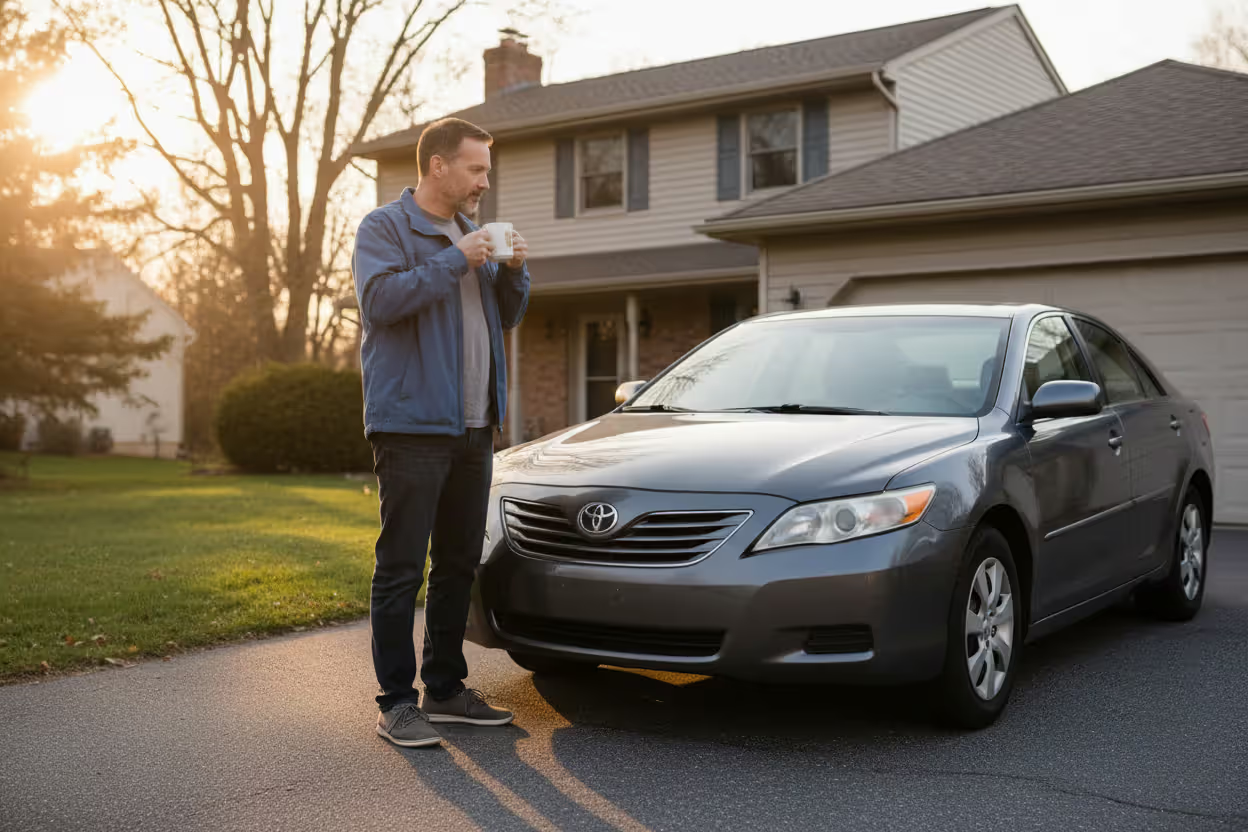
Buyers fixated on monthly payments have options beyond stretching to 96 months. A larger down payment produces the same payment reduction without the interest penalty. Increasing your down payment from 10% to 20% on a $35,000 vehicle cuts the financed amount by $3,500, reducing monthly payments by roughly $60-70 on a 60-month loan—comparable to extending the term by 12 months.
Choosing a less expensive vehicle delivers even larger benefits. Dropping from a $40,000 SUV to a $32,000 sedan saves $8,000 in financed amount, cutting monthly payments by $140-160 on equivalent terms. This approach avoids both the interest penalty and the negative equity trap.
Refinancing strategies can rescue borrowers already locked into long terms. After 12-24 months of on-time payments, your credit score may have improved enough to qualify for a lower rate on a shorter remaining term. Refinancing a 96-month loan at month 24 into a new 60-month loan eliminates 12 months of payments and typically reduces the interest rate, despite resetting the amortization schedule.
Lease options deserve consideration for buyers who trade frequently. A three-year lease with a moderate payment keeps you in a newer vehicle without the negative equity concerns that plague long-term financing. The total cost often exceeds buying and keeping a vehicle for 10+ years, but beats the financial damage of serial trading with maximum-length loans.
Some buyers split the difference by choosing 60-month terms and making extra principal payments when possible. This preserves flexibility—you're not obligated to the higher payment of a 36-month loan, but you can accelerate payoff when finances allow. The key is ensuring your lender applies extra payments to principal rather than prepaying interest.
Waiting to buy remains the most overlooked alternative. Another six months of saving while driving your current vehicle might generate enough down payment to avoid extended financing entirely. This requires patience in a culture that prioritizes immediate gratification, but the financial benefit is undeniable.
Author: Olivia Stratford;
Source: ruralxchange.net
FAQ
The longest car loan terms available in 2026—stretching to 96 months and occasionally beyond—provide payment relief at substantial long-term cost. While these extended terms make expensive vehicles technically affordable on a monthly basis, they trap borrowers in years of negative equity and impose thousands in additional interest charges.
Maximum-length financing makes sense only in narrow circumstances: new vehicles with strong resale value, promotional interest rates below market averages, and buyers committed to keeping vehicles well beyond the loan term. For most people, terms exceeding 60 months create more problems than they solve.
Before accepting the longest available term, run the numbers on alternatives. A larger down payment, a less expensive vehicle, or simply waiting a few months to save more cash will almost always produce better financial outcomes than stretching to 84 or 96 months. The lower monthly payment looks attractive on the dealership paperwork, but the total cost and negative equity consequences follow you for years.
If you're already locked into a maximum-length loan, prioritize paying it down faster than required. Even an extra $50-100 monthly toward principal can shave months off the term and save thousands in interest. Better yet, refinance to a shorter term once your credit improves or your equity position strengthens.
The auto financing market will continue offering extended terms as long as buyers accept them, but that doesn't make them wise choices. Treat 96-month loans as last-resort options rather than standard practice, and you'll avoid one of the most common financial mistakes American car buyers make.
Related Stories

Read more

Read more




The content on this website is provided for informational and educational purposes only. It offers general guidance on topics related to car loans, auto refinancing, interest rates, credit scores, loan terms, and vehicle financing options. The information presented should not be considered financial, legal, or professional advice.
Auto loan terms, interest rates, approval requirements, and refinancing options may vary depending on the lender, credit profile, and individual circumstances.
While we aim to keep the information accurate and up to date, we make no guarantees regarding its completeness or reliability. Visitors should review official loan documents and consult with qualified financial professionals before making decisions related to auto loans or refinancing.