

Customer reviewing new car financing options at a dealership
New Car Loan Rates Guide

Financing a new vehicle means understanding how lenders price their money. The rate you receive determines how much you'll pay beyond the sticker price, and even a single percentage point can translate into thousands of dollars over the life of your loan.
Most buyers focus on monthly payments, but the interest rate tells the real story. A $35,000 vehicle financed at 5.5% for 60 months costs roughly $2,900 more than the same loan at 3.5%. That difference funds a decent vacation or covers insurance for two years.
How New Car Loan Interest Rates Work
Auto lenders quote rates in two ways: APR (annual percentage rate) and interest rate. The interest rate represents the cost of borrowing the principal amount. APR includes that rate plus any fees the lender charges—origination fees, documentation fees, or other costs rolled into the loan.
For most new car loans, these numbers sit close together because auto financing typically carries fewer fees than mortgages or personal loans. A lender might quote 6.2% interest with a 6.3% APR, meaning minimal additional costs. Always compare APRs when shopping, since that figure captures the true cost.
Term length directly affects your rate. Lenders charge less for 36-month loans than 72-month loans because shorter terms mean less risk. Your money returns faster, and the vehicle retains more value relative to the loan balance. A credit union might offer 4.9% for three years but 6.4% for six years on identical creditworthiness.
The math works against longer terms in two ways. Higher rates mean more interest, and more months mean that higher rate applies longer. A 72-month loan at 7% costs nearly double the interest of a 48-month loan at 5.5%, even though the rate difference seems modest.

Author: Derek Halvorsen;
Source: ruralxchange.net
Current New Car Loan Rates by Lender Type
New car loan rates in 2026 reflect the Federal Reserve's monetary policy adjustments over the past two years. Average rates vary significantly based on where you borrow and what your credit profile looks like.
Banks typically quote rates between 5.8% and 11.2% depending on credit tier. National banks tend toward the higher end of that range, while regional banks compete more aggressively in their markets. Bank of America and Chase generally price within 0.5% of each other for comparable borrowers.
Credit unions consistently undercut banks by 0.5% to 1.5%. Members with excellent credit often qualify for rates between 4.9% and 6.2%. Navy Federal Credit Union and Pentagon Federal Credit Union frequently advertise rates below 5% for their best customers, though membership requires military affiliation or family connection.
Online lenders like LightStream and MyAutoloan occupy middle ground, offering 5.2% to 9.8% depending on credit quality. These platforms aggregate offers from multiple lenders, which creates competition but also introduces variability in underwriting standards.
Dealer financing deserves scrutiny. Manufacturers subsidize rates through their captive finance arms—Toyota Financial Services, GM Financial, Ford Credit—particularly on slower-selling models. You might find 2.9% promotional financing on a new Camry or 0% on leftover 2025 inventory. These deals come with trade-offs: limited negotiation on vehicle price, restrictions on which trim levels qualify, and shorter promotional terms.
Average New Car Loan Rates by Credit Score and Lender Type
| Credit Score Range | Credit Union Rate | Bank Rate | Online Lender Rate |
| 720+ (Excellent) | 4.9%–6.2% | 5.8%–7.1% | 5.2%–6.9% |
| 690–719 (Good) | 6.3%–8.1% | 7.2%–9.3% | 7.0%–9.0% |
| 660–689 (Fair) | 8.2%–10.5% | 9.4%–11.8% | 9.1%–11.5% |
| 620–659 (Subprime) | 10.6%–13.9% | 11.9%–15.2% | 11.6%–14.8% |
These ranges represent 60-month loan terms. Shorter terms typically run 0.5%–1.0% lower; longer terms add 0.5%–1.5%.
Credit Union New Car Loan Rates vs. Bank Rates
Credit unions operate as member-owned cooperatives rather than profit-driven corporations. That structural difference translates into lower rates because credit unions return earnings to members through better loan terms and higher savings rates.
The rate advantage averages about 1.2 percentage points across credit tiers. A borrower with a 680 credit score might receive 8.8% from a credit union versus 10.1% from a regional bank. Over a $30,000 loan, that saves roughly $1,100 in interest.
Membership requirements create the main barrier. Some credit unions restrict membership to specific employers, geographic areas, or professional associations. Others allow anyone to join by making a small donation to an affiliated nonprofit. Navy Federal requires military connection, but Alliant Credit Union accepts anyone who joins a partner organization for a $5 fee.
Credit unions typically move slower than banks. Underwriting might take three to five business days versus same-day decisions from large banks with automated systems. If you're buying at a dealership and need immediate financing, that delay complicates the process.
Banks offer broader accessibility and faster decisions. They also provide relationship benefits—bundling auto loans with checking accounts or mortgages sometimes unlocks rate discounts. Chase gives 0.25% off auto loan rates for customers who set up automatic payments from a Chase checking account.
The best approach involves checking both. Apply to your local credit union first if you qualify for membership, then compare that offer against bank rates. The 30 minutes spent on a second application often pays for itself many times over.
Consumers leave money on the table by accepting the first rate they're quoted. In 2026's competitive lending environment, shopping three lenders typically reveals a 0.8% to 1.5% spread between the highest and lowest offers for the same borrower. On a $35,000 loan, that's $1,500 to $2,800 in potential savings for an afternoon of rate shopping
— Michael Chen
What Affects Your New Car Financing Rate
Lenders evaluate risk through multiple factors, each carrying different weight in their pricing models. Understanding these variables helps you optimize your application and anticipate the rate you'll receive.
Credit Score Requirements
Credit scores dominate rate determination. FICO scores above 740 unlock the best rates, while scores below 620 push you into subprime territory with rates that can exceed 14%.
The impact isn't linear. Improving from 620 to 660 might drop your rate by 2.5%, but improving from 740 to 780 only saves 0.3%. Lenders price risk aggressively at lower tiers because default rates rise sharply below 660.
Check your credit reports from all three bureaus before applying. Auto lenders often use FICO Auto Scores, which weight auto-related credit history more heavily than standard FICO scores. Paying off an old auto loan or disputing errors on your report can boost your score quickly.
Loan Term Length
Lenders charge premium rates for extended terms because risk compounds over time. A borrower who maintains good standing for 36 months proves more reliable than one who must perform for 84 months.
Terms beyond 60 months also create negative equity problems. Vehicles depreciate faster than loan balances decline on long-term financing, leaving borrowers underwater for years. Lenders price this risk into rates, adding 1% to 2% for 72- or 84-month terms compared to 48-month loans.
The monthly payment temptation leads buyers astray. A $40,000 vehicle at 7% for 84 months carries a $546 payment, while 60 months at 5.5% requires $765. The longer loan looks affordable but costs $5,900 more in interest.
Down Payment Amount
Larger down payments reduce lender risk by creating immediate equity. If you put 20% down on a $35,000 vehicle, the lender only risks $28,000 while the collateral starts at full value. That cushion earns you better rates.
Many lenders tier pricing by loan-to-value ratio. Financing 90% of the purchase price might cost 0.5% more than financing 80%. Some credit unions offer their best rates only when LTV stays below 85%.
Down payments also affect approval odds. Borrowers with marginal credit often need 15% to 20% down to qualify at all, while excellent credit might require nothing down for premium rates.
Vehicle Type and Age
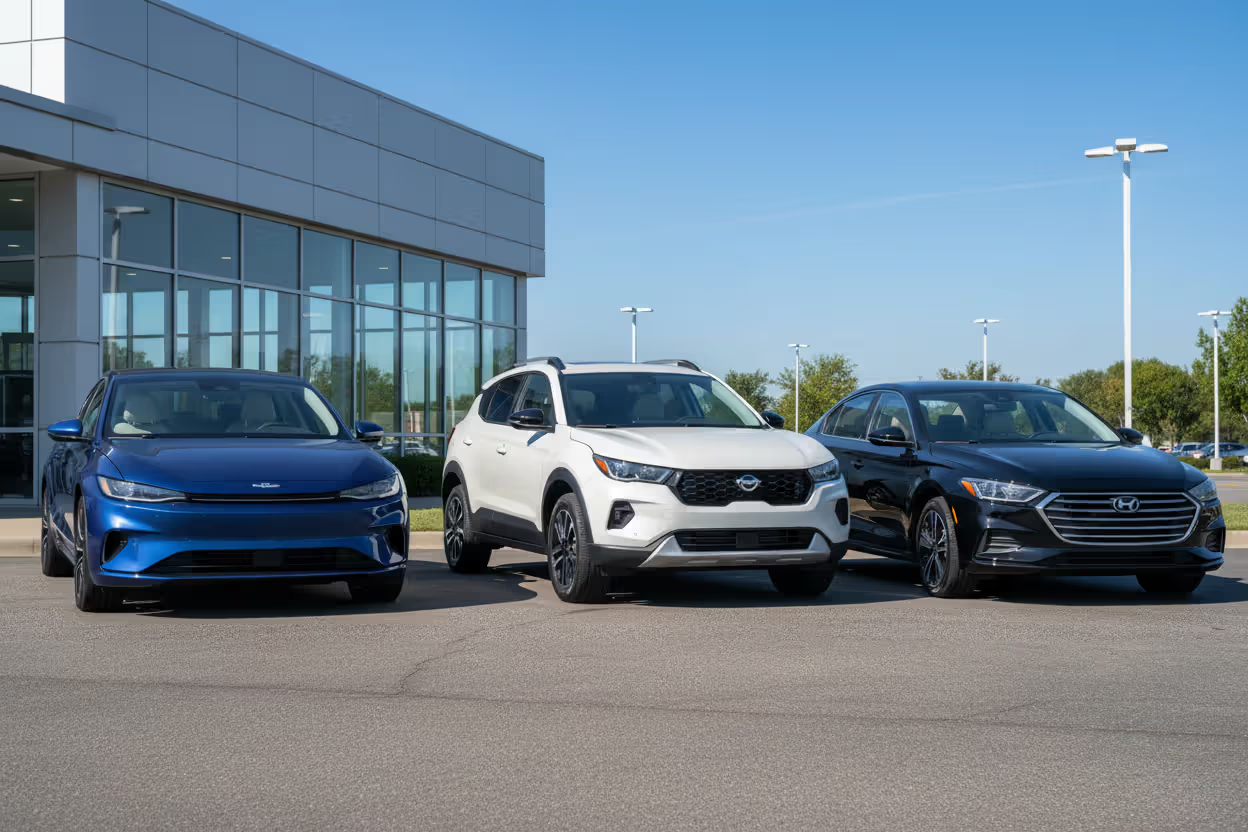
Lenders prefer lending on vehicles that hold value and sell easily if repossessed. A Toyota RAV4 or Honda CR-V qualifies for better rates than a Maserati Ghibli, even though the Maserati costs more. High-volume models with strong resale values present less risk.
New cars always rate better than used because condition is known and warranty coverage protects value. The gap between new and used car rates typically runs 1% to 2%, though certified pre-owned vehicles from manufacturers sometimes qualify for new-car rates.
Electric vehicles occupy interesting territory. Some lenders offer rate discounts on EVs as environmental incentives, while others charge premiums due to uncertainty about long-term battery values. Tesla vehicles generally qualify for standard rates, but less common EV brands might face 0.5% rate increases.
Author: Derek Halvorsen;
Source: ruralxchange.net
How to Get the Lowest New Car Auto Loan Rate
Rate shopping requires strategy beyond submitting random applications. Lenders evaluate your approach, and smart preparation unlocks better terms.
Start 30 to 45 days before you plan to buy. This window gives you time to improve your credit score, gather documentation, and compare offers without rushing. Credit inquiries for auto loans within a 14-day period count as a single inquiry for scoring purposes, so concentrate your applications.
Get pre-approved from at least three lenders before visiting dealerships. Pre-approval establishes your baseline rate and strengthens negotiating position. Dealers can't lowball you on trade-in value and make it back on financing if you arrive with outside financing already secured.
Credit unions should anchor your search. Join one if you don't already belong, then apply there first. Use that rate as your benchmark for evaluating bank and online lender offers.
Negotiate the vehicle price separately from financing. Dealers mix these variables to obscure the true cost. Agree on the out-the-door price before discussing financing, and never frame negotiations around monthly payments.
Consider timing strategically. Manufacturers boost incentives at quarter-end and year-end to hit sales targets. December and March often feature the best promotional rates, sometimes dropping below 2% on select models. These deals require excellent credit and limit negotiation on price, but the interest savings can outweigh modest price concessions.
Avoid add-ons that don't affect the rate but inflate the loan amount. Extended warranties, gap insurance, and paint protection increase what you're borrowing, which increases interest costs even at low rates. Buy these separately if you want them, or skip them entirely.
Ask about rate discounts for automatic payments, existing customer relationships, or professional affiliations. Many lenders offer 0.25% to 0.50% reductions that don't appear in advertised rates. You have to ask specifically.

Author: Derek Halvorsen;
Source: ruralxchange.net
Common Mistakes When Comparing New Car Loan Rates
Buyers repeatedly make the same errors when evaluating financing, often costing themselves thousands without realizing it.
Focusing exclusively on monthly payments obscures the total cost. A dealer might offer a $50 lower monthly payment by extending the term from 60 to 72 months, but you'll pay $2,000 more in interest. Always calculate total interest paid, not just the monthly obligation.
Ignoring total interest cost leads to poor term selection. Online calculators show this clearly: a $30,000 loan at 6.5% costs $3,060 in interest over 48 months but $5,230 over 72 months. That extra $2,170 represents money you could invest or save instead.
Skipping credit unions means missing the consistently lowest rates. Many buyers don't realize they qualify for membership or assume the hassle isn't worth it. Spending 20 minutes joining a credit union to save $1,200 in interest pays better than most part-time jobs.
Accepting the first offer reflects poor negotiation. Lenders expect you to shop around, and initial quotes often include room for improvement. Telling a loan officer you have a better offer elsewhere frequently unlocks a lower rate without additional documentation.
Failing to check multiple credit bureaus creates blind spots. Lenders pull different bureaus, and errors on one report might not appear on others. A collections account erroneously reported to Experian but not Equifax could cost you 2% in rate if your lender uses Experian.
Applying for other credit during the car-buying process damages your score. Opening a new credit card or applying for a personal loan while shopping for auto financing triggers additional hard inquiries and reduces your average account age. Wait until after your auto loan closes.
Frequently Asked Questions About New Car Loan Rates
Securing a favorable new car loan rate requires understanding how lenders price risk, comparing offers across multiple institution types, and negotiating from an informed position. Credit unions provide the most consistent value for rate-conscious borrowers, while banks offer convenience and relationship discounts. Promotional rates from manufacturer finance arms sometimes beat both, though with restrictions.
Your credit score remains the dominant factor in rate determination, but term length, down payment, and vehicle selection also influence pricing. Shopping at least three lenders during a concentrated period protects your credit score while revealing the true competitive rate for your situation.
The difference between accepting the first offer and conducting thorough rate shopping typically exceeds $1,500 on a standard new car loan. That return on a few hours of research makes rate shopping one of the highest-value activities in the car-buying process. Focus on total interest cost rather than monthly payments, and remember that the lowest rate doesn't always come from the most obvious source.
Related Stories

Read more

Read more




The content on this website is provided for informational and educational purposes only. It offers general guidance on topics related to car loans, auto refinancing, interest rates, credit scores, loan terms, and vehicle financing options. The information presented should not be considered financial, legal, or professional advice.
Auto loan terms, interest rates, approval requirements, and refinancing options may vary depending on the lender, credit profile, and individual circumstances.
While we aim to keep the information accurate and up to date, we make no guarantees regarding its completeness or reliability. Visitors should review official loan documents and consult with qualified financial professionals before making decisions related to auto loans or refinancing.