

Buyer reviewing a car loan contract with a finance manager at a dealership
Car Loan APR Explained for US Buyers

You're sitting at the dealership, and the finance manager slides a contract across the desk. Most buyers zoom straight to that monthly payment number—$450 sounds doable, right? But tucked in the fine print sits a figure that actually determines what you'll pay: the APR. Miss this detail and you might hand over an extra $3,000 to $5,000 before you've made your final payment.
Car loan APR isn't exciting. Nobody dreams about percentage rates. But fifteen minutes spent understanding this number protects you from predatory deals and keeps more cash in your account.
What Is APR on a Car Loan?
Think of APR—the annual percentage rate—as the real price tag on borrowed money. When someone asks "what is apr on a car loan," they're really asking: what does this loan actually cost me each year?
Your basic interest rate? That's just part of the equation. The car loan apr meaning includes that interest rate plus every mandatory fee your lender charges. We're talking origination fees, documentation charges, processing costs, and sometimes even mandatory insurance tied to the loan.
Congress passed the Truth in Lending Act specifically to force lenders to show you this all-in number. Before this law, banks could advertise low rates while burying expensive fees in the paperwork. Now they must calculate and display the annual percentage rate car loan total.
Let's say you're borrowing $30,000 at 6% interest. Sounds straightforward. But your lender also charges an $800 origination fee. That fee gets spread across your loan term, pushing your actual APR to around 6.4%. The longer your loan, the less these upfront fees impact the APR percentage—but you still pay them.
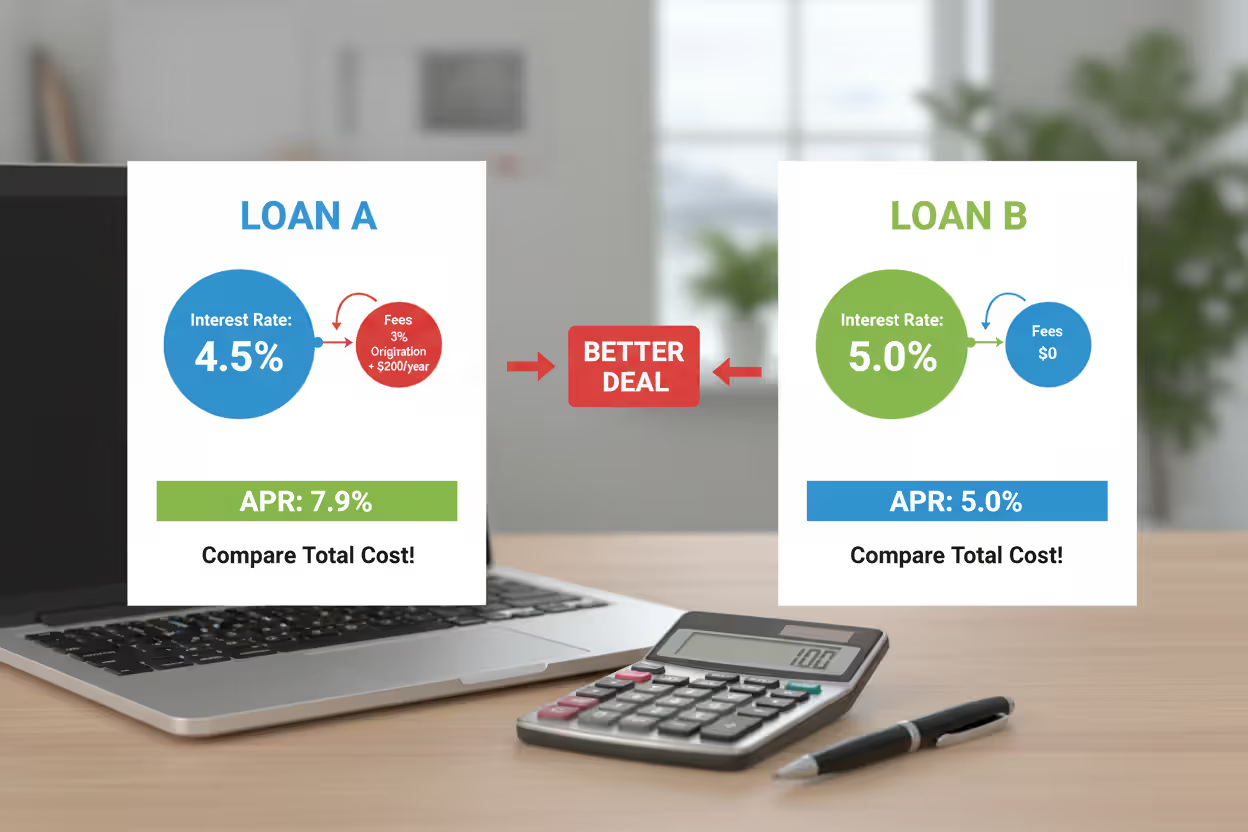
Here's why lenders use this metric: it creates apples-to-apples comparisons. Bank A might advertise 5% interest with $1,500 in fees. Bank B offers 5.5% with zero fees. Which is cheaper? Without APR, you'd need a calculator and patience. With APR, you compare 5.4% against 5.5% and instantly know Bank B wins.
Author: Olivia Stratford;
Source: ruralxchange.net
APR vs Interest Rate on Car Loans
People use these terms interchangeably. Big mistake.
Your interest rate is the percentage charged against your remaining loan balance—nothing more. Borrow $20,000 at 5% interest for five years, and that 5% calculates how much interest accumulates monthly on whatever you still owe.
APR takes that same 5% interest rate and adds in every fee distributed across your repayment period. APR equals or exceeds your interest rate. It never drops below.
Dealership ads love shouting "5% financing available!" That's the interest rate. Once you sit down and read the actual contract, the APR might read 5.3%, 5.9%, even 6.2%. The apr vs interest rate car loan gap comes entirely from fees.
Look at two versions of the same loan to see the difference:
| What You're Comparing | Just the Interest Rate | Full APR With Fees |
| Amount borrowed | $25,000 | $25,000 |
| Interest rate charged | 5.0% | 5.0% |
| Upfront fees | $0 (for comparison) | $1,200 |
| Loan length | 60 months | 60 months |
| Your actual APR | 5.0% | 5.47% |
| Payment each month | $471.78 | $477.42 |
| Total interest you'll pay | $3,306.80 | $3,645.20 |
| Everything you'll pay back | $28,306.80 | $28,645.20 |
Those $1,200 in fees cost you an additional $338.40 by the time you've paid everything off. The APR captures this reality in one number.
When you're comparing loan offers, use APR as your measuring stick. A lender advertising 4.9% interest with $1,500 in fees might actually cost more than one offering 5.2% interest with only $300 in fees. Run the APR calculation and you'll know for certain.
How APR Works on a Car Loan
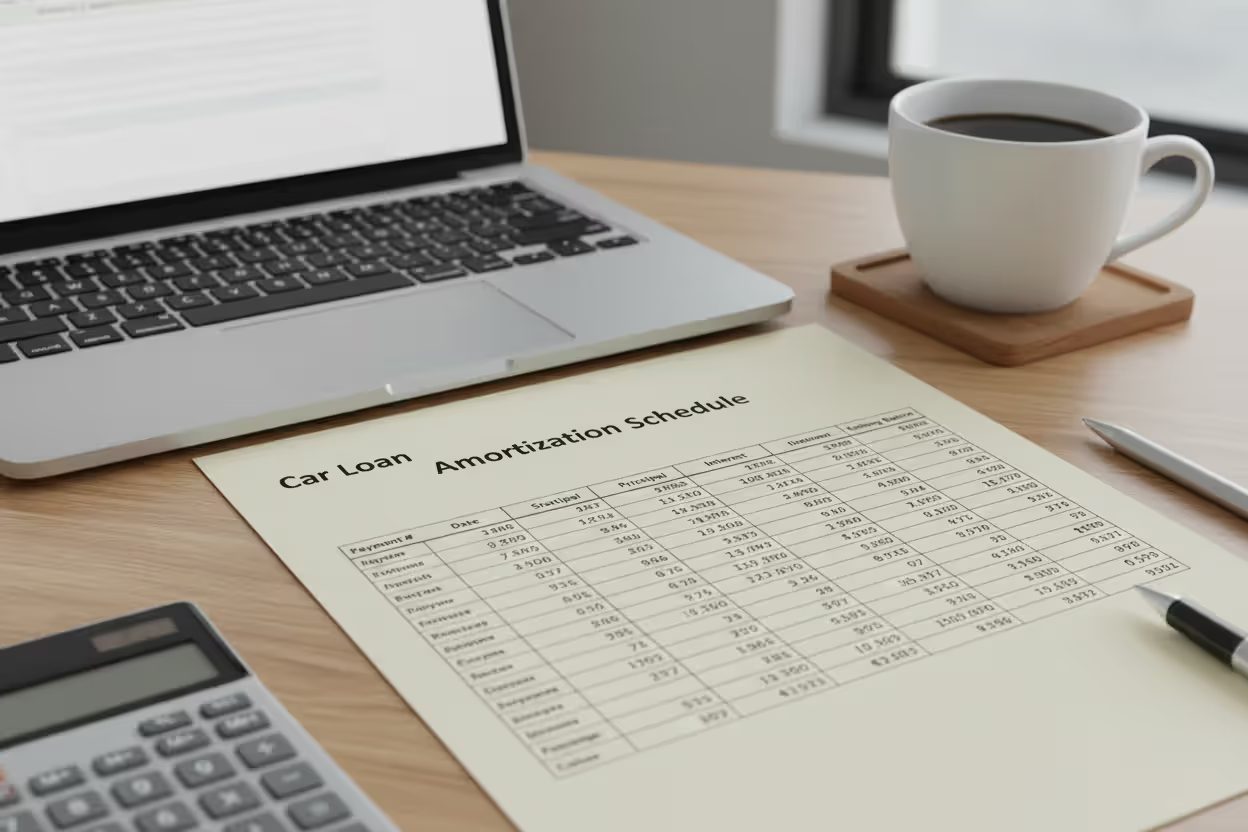
Understanding how apr works on a car loan means wrapping your head around amortization—the process of gradually paying down your balance through scheduled payments.
Each monthly payment splits two ways: some reduces your principal (the amount you borrowed), and some covers interest (what you're paying for the privilege of borrowing). Early in the loan, interest dominates. As months pass, more of each payment chips away at the principal.
Here's the month-by-month process:
Month one: Convert your annual APR to a monthly rate. Take a 6% APR and divide by twelve. You get 0.5% per month (or 0.005 in decimal form).
Calculate your first interest charge. Multiply your loan balance by that monthly rate. On a $30,000 loan at 6% APR, your first month's interest equals $30,000 × 0.005 = $150.
Figure out what reduces your principal. Subtract the interest from your total payment. If you're paying $580 monthly, you subtract $150 for interest. That leaves $430 attacking your actual loan balance.
Your new balance for next month. Take $30,000 and subtract that $430. You now owe $29,570.
Repeat these steps. Next month's interest gets calculated on $29,570, giving you $147.85 in interest. More of your payment now goes toward principal.
This cycle continues until you've paid everything off. The APR controls how much interest builds each month, while the amortization schedule shows exactly where every dollar of every payment goes.
Author: Olivia Stratford;
Source: ruralxchange.net
One important detail: car loans use simple interest, not compound interest. Your interest only applies to your current balance—you're not paying interest on interest like you would with a credit card. This saves you money compared to compound interest products.
What Affects Your Car Loan APR?
Six factors determine the APR you'll actually get approved for.
Credit score dominates everything else. Lenders treat your credit score like a crystal ball predicting whether you'll repay them. Someone with a 750 score typically qualifies for rates 3 to 5 percentage points lower than someone at 620. On $30,000 financed over five years, the difference between 4% APR and 9% APR equals roughly $4,000 in extra interest.
Current market rates in 2026 break down like this by credit tier:
| Your Credit Score | New Car APR Range | Used Car APR Range |
| 781-850 (Excellent credit) | 4.5%–5.8% | 5.2%–6.5% |
| 661-780 (Good credit) | 5.9%–7.4% | 6.6%–9.2% |
| 601-660 (Fair credit) | 8.6%–11.9% | 10.8%–15.6% |
| 501-600 (Poor credit) | 12.4%–16.8% | 16.2%–20.3% |
| 300-500 (Bad credit) | 17.5%–21.9% | 21.0%–24.9% |
How long you're borrowing matters. Longer loans usually cost more. A 72-month loan might carry an APR that's half a point to a full point and a half higher than a 48-month loan, even for identical borrowers. Lenders charge extra for the extended risk period.
Your down payment size changes your rate. Put down 20% instead of 5%, and you might knock 0.25 to 0.75 percentage points off your APR. When you borrow less relative to the car's value, the lender faces less risk.
New versus used makes a difference. Brand-new cars typically get lower APRs because they're worth more and depreciate predictably. Used car loans often run 1 to 3 percentage points higher. If the car is more than six years old, expect even steeper rates.
Where you borrow changes your rate. Credit unions often beat banks by 0.5 to 1.5 percentage points, and both usually beat dealer financing. Online lenders fall somewhere in the middle. Credit unions operate as nonprofits, so they pass savings directly to members.
The broader economy sets baseline rates. When the Federal Reserve raises rates to fight inflation, car loan APRs rise everywhere. When the Fed cuts rates, borrowing gets cheaper. Throughout 2026, rates have stabilized after the volatility we saw earlier, though they remain higher than the rock-bottom rates during 2020-2021.

Author: Olivia Stratford;
Source: ruralxchange.net
How to Get the Best APR on Your Car Loan
Smart preparation can shave multiple percentage points off your rate.
Fix your credit score first. Even gaining 20 points might bump you into a better rate category. Pay credit card balances below 30% of your limits, dispute any errors on your credit reports, and avoid opening new credit accounts in the 90 days before you apply. If you're borderline on credit score, waiting three months to improve it could save you $1,500 over the loan's life.
Get pre-approved from at least three lenders. Apply at your credit union, a bank where you already have accounts, and two online lenders. Each one assesses risk differently and has different cost structures, so their APR offers will vary. Having three competing offers gives you negotiating power and shows you what your credit profile actually commands in the current market. Keep all your applications within a two-week window—credit scoring models treat multiple auto loan inquiries in this period as a single event.
Put more money down if possible. Offering 20% down instead of 10% often qualifies you for a lower APR tier. Loan-to-value ratios matter to lenders. A $30,000 car backing a $24,000 loan (80% LTV) presents less risk than the same car securing a $27,000 loan (90% LTV).
Choose a shorter loan term when your budget allows. Forty-eight-month financing almost always gets lower APRs than 60-month or 72-month loans. Yes, your monthly payment increases, but you'll pay less interest overall and build equity faster. Calculate both scenarios to confirm the payment difference fits comfortably in your budget.
Negotiate the dealer's quoted rate. Dealers routinely mark up the lender's actual rate by 1 to 2 percentage points as profit. When you've got pre-approval at 5.5% but the dealer quotes you 7%, show them your pre-approval paperwork. They'll often match your rate or come close. Don't be afraid to walk away if they won't budge—dealers make serious money on financing and would rather accept a smaller markup than lose the entire sale.
Time your purchase strategically. End of month, end of quarter, and end of year often bring manufacturer incentives, including special APR financing. Some automakers offer 0% APR promotions on specific models, though these usually require excellent credit and you might have to give up cash rebates to get the promotional rate.
Check if you qualify for a credit union. If you're not already a member, many credit unions have easy membership requirements—sometimes just living in a certain area or working in a particular industry. Membership fees typically run $5 to $25, and the APR savings can be substantial.
Most car buyers obsess over the monthly payment while ignoring APR, which is exactly what dealers count on. Just two percentage points on $30,000 financing pulls roughly $3,200 extra out of your pocket over five years. That's real money that could fund your next down payment or shore up your emergency fund. Always confirm your APR before signing anything, and never let a dealer rush you through the finance paperwork
— Michael Torres
Common Car Loan APR Mistakes to Avoid
Even savvy buyers fall into traps that inflate their borrowing costs.
Focusing only on the monthly payment: Dealers love asking "What payment works for your budget?" because it lets them manipulate loan length and APR while keeping the payment in your stated range. A $400 monthly payment sounds manageable, but it might come from stretching financing to 84 months at 9% APR instead of 60 months at 5%. You'll spend thousands more in interest. Ask for the APR and total loan cost, not just the payment amount.
Ignoring what loan length actually costs: Seventy-two-month financing at 6% APR might look smarter than 48-month terms at 5.5% APR because the payment is lower. Over the full term, though, you'll pay substantially more interest and stay underwater (owing more than the car's value) for years. Shorter terms cost less overall, even when the APR is slightly higher.
Skipping the fine print: Some loans have prepayment penalties that charge fees if you pay off early. Others pack in mandatory add-ons like GAP insurance or extended warranties. These bloat your loan principal and effective APR. Read every page of your contract and question anything you don't completely understand.
Accepting dealer rate markups blindly: Dealers often position themselves as doing you a favor by "getting you approved" when they've actually marked up the lender's rate. If a bank approves you at 6% but the dealer writes the contract at 7.5%, they pocket the difference. This practice is legal but expensive for you. Get your own financing or at least secure pre-approval to know what market rates look like.
Taking the first rate quoted: Whether from dealers, banks, or online lenders, the first APR you hear is rarely their best available rate. Lenders often start high to test whether you'll accept it. Politely asking "Is there any flexibility on this rate?" or mentioning you have other offers can sometimes drop your APR by 0.5 to 1 percentage point.
Forgetting to factor in fees: One lender might advertise great APRs but charge $1,000 in origination fees, while another offers slightly higher APRs with only $200 in fees. APR disclosure should include these costs, but some lenders bury them in the paperwork. Ask for a complete breakdown of all costs before you commit.

Author: Olivia Stratford;
Source: ruralxchange.net
Frequently Asked Questions About Car Loan APR
Your car loan APR determines what you actually pay to finance a vehicle, and understanding it puts you in control of one of life's biggest purchases. The difference between a great APR and a mediocre one can cost you thousands of dollars over the loan's life—money that could go toward a bigger down payment on your next car, your emergency fund, or other financial goals.
Take time to check your credit score, get pre-approved from multiple lenders, and compare total costs using APR as your main measuring stick. Don't let dealers rush you through the finance paperwork, and never focus only on the monthly payment amount. APR tells the complete story of what borrowing will cost.
With the strategies outlined here, you're ready to spot predatory lending, negotiate better terms, and make informed decisions that protect your financial future. The car you buy matters, but the loan you sign matters just as much.
Related Stories

Read more

Read more


The content on this website is provided for informational and educational purposes only. It offers general guidance on topics related to car loans, auto refinancing, interest rates, credit scores, loan terms, and vehicle financing options. The information presented should not be considered financial, legal, or professional advice.
Auto loan terms, interest rates, approval requirements, and refinancing options may vary depending on the lender, credit profile, and individual circumstances.
While we aim to keep the information accurate and up to date, we make no guarantees regarding its completeness or reliability. Visitors should review official loan documents and consult with qualified financial professionals before making decisions related to auto loans or refinancing.