

Car buyer reviewing auto loan documents with calculator and car keys
Average APR for Car Loan Rates in 2025

Most Americans can't write a check for a new vehicle—that's just reality. Instead, roughly 85% of buyers finance their purchase, which means the interest rate you get literally determines how much that car actually costs you. I've seen people celebrate negotiating $500 off the sticker price, then lose $3,000 to a bad financing rate. Knowing what rates look like right now for someone in your situation? That's where the real savings happen.
What Is APR on a Car Loan?
Think of APR as the "real" price tag on borrowed money. Your lender might quote you a 6% interest rate, but the APR tells the complete story—it's interest plus all those fees they're rolling into your loan. We're talking about origination charges, documentation fees, sometimes processing costs.
Here's how it works: lenders take their base interest rate, add in mandatory fees, then calculate what percentage of your loan amount that total represents annually. So that 6% interest rate? Once you factor in $400 in fees on a $25,000 loan, you're actually looking at closer to 6.3% APR.
Why does this matter? Because you can't compare loans by just looking at interest rates—that's comparing apples to oranges. The dealership might advertise 5.5% interest but load up on fees that push the real APR to 6.2%. Meanwhile, your credit union quotes 5.9% interest with minimal fees for a 6.0% APR. Suddenly the credit union is cheaper, even though their interest rate looked higher.
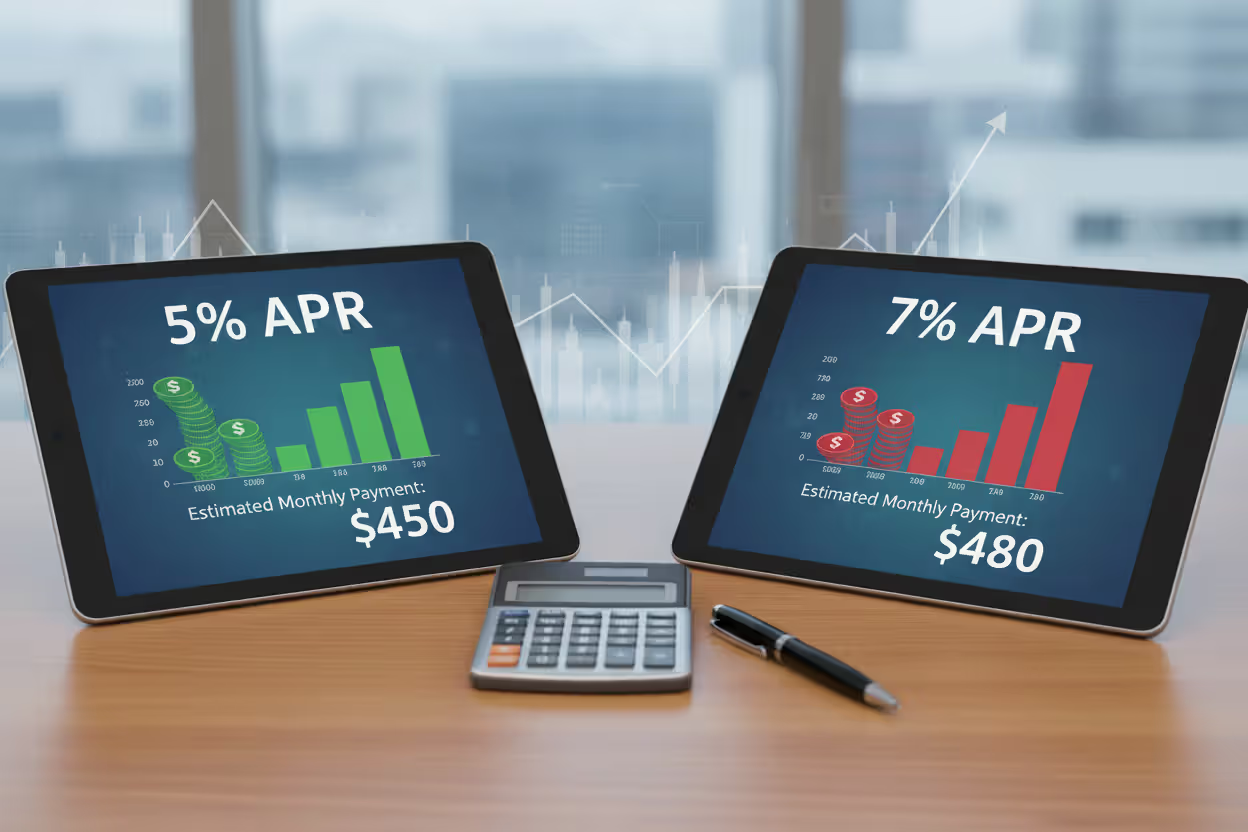
Your monthly payment gets calculated using the APR, not just the interest rate. And over 60 months on a $30,000 loan, the difference between 5% and 7% APR? That's roughly $1,800. Not pocket change.
Author: Brandon Ellsworth;
Source: ruralxchange.net
Current Average Car Loan APR by Credit Score
Here's the uncomfortable truth: your credit score essentially determines which pricing tier you're shopping in. It's like having a coupon that some people get and others don't. Someone with a 750 score walks into the same dealership as someone with a 620, looks at the same car, and gets quoted a rate that's 5-8 percentage points lower.
Right now in 2025, here's what the landscape actually looks like:
| Credit Score Range | Credit Tier | Average APR (New Car) | Average APR (Used Car) |
| 720 and above | Excellent | 5.8% - 7.2% | 7.1% - 8.9% |
| 690-719 | Good | 7.5% - 9.1% | 9.3% - 11.2% |
| 630-689 | Fair | 10.2% - 13.8% | 13.5% - 17.1% |
| Below 630 | Poor | 14.9% - 18.5% | 18.2% - 21.4% |
Now, these aren't carved in stone. They're national averages, which means half the deals come in better and half come in worse. Your local credit union might beat these numbers. An online lender might match them. That sketchy buy-here-pay-here lot down the street will absolutely crush you with something way above these ranges.
Geography plays a bigger role than most people realize. I've seen identical credit profiles get quoted 8.5% in Minneapolis and 10.2% in rural Mississippi for the same car. More lenders competing in your area generally means better rates. States with higher average credit scores tend to have more competitive pricing overall.
And here's something dealers won't tell you: your score is just the starting point. Two people with 680 scores might get different rates because one has a car loan they paid perfectly for three years, while the other's 680 comes from having almost no credit history at all. Lenders look at the whole picture, not just that three-digit number.
New vs. Used Car Loan APR Differences
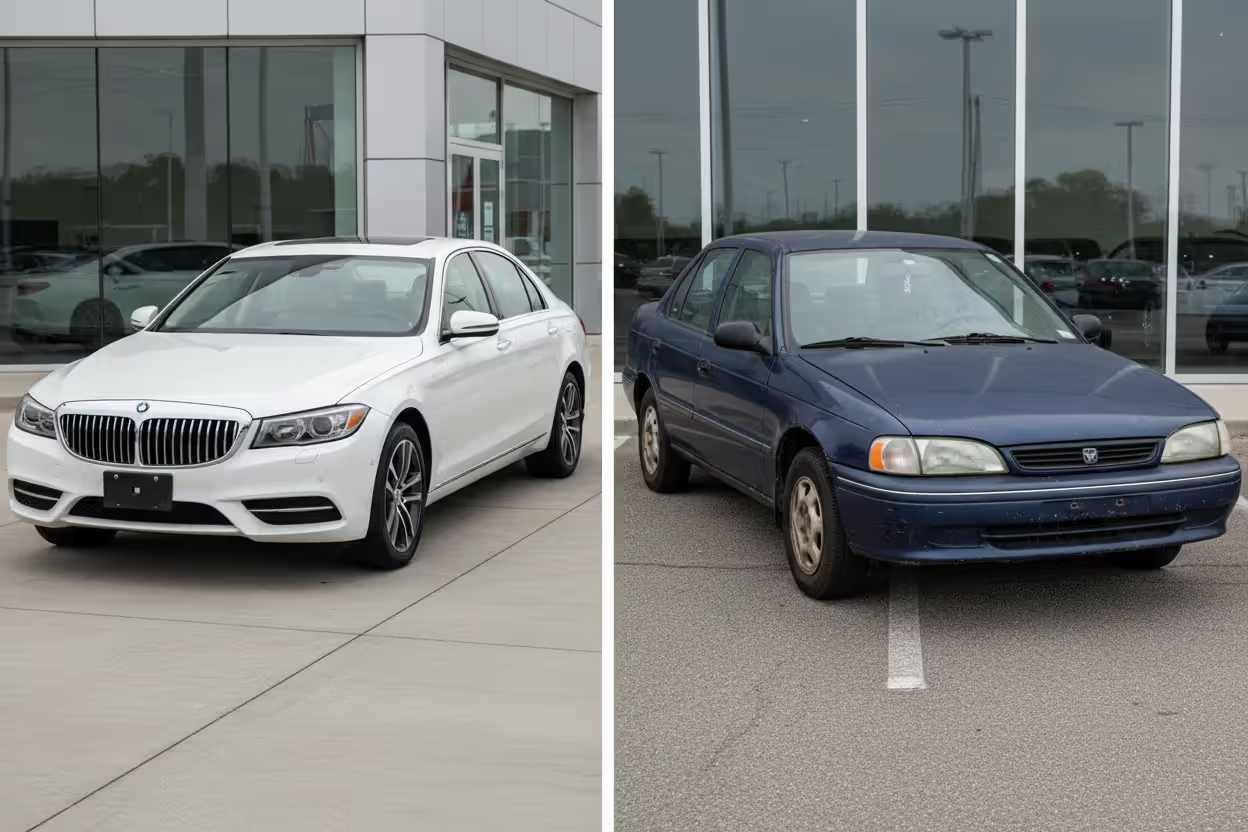
Walk into any lender's office with plans to finance a used car, and you'll immediately face higher rates—typically 1.5 to 3 percentage points higher than you'd get on a brand new vehicle. Sometimes more if the car's getting up there in age.
The reason? Pure risk calculation. Banks know that used cars break down more often. They know the maintenance history is a mystery—maybe the previous owner changed the oil religiously, maybe they ignored that check engine light for two years. When people hit financial trouble, they're more likely to let a used car get repossessed than a shiny new one they're emotionally attached to.
Plus, if the bank has to take your car back, they need to sell it to recover their money. A new 2025 Toyota Camry has a predictable resale value that every dealer in America will bid on. That 2017 Nissan Altima with 89,000 miles and an unknown maintenance record? Much harder to move, and they'll get less for it at auction.
Certified pre-owned programs split the difference. You're still buying used, but the manufacturer has inspected everything, added a warranty, and essentially vouched for the car. CPO rates typically run just 0.5% to 1% above new car rates—way better than regular used car financing.
Age matters tremendously here. Finance a three-year-old car and you might see 2% higher than new. Try to finance a ten-year-old vehicle with 120,000 miles? Some lenders won't touch it at all. Others will want 15-18% even if your credit is decent. They're treating it almost like an unsecured loan at that point.
Author: Brandon Ellsworth;
Source: ruralxchange.net
What Affects Your Car Loan APR?
Your credit score gets all the attention, but it's just one ingredient in a complicated recipe. Lenders are looking at multiple factors, weighing them against each other, trying to predict whether you'll actually pay them back.
Credit Score and Payment History
Sure, your 710 credit score matters. But what's underneath that number matters more than people think. Lenders don't just see "710"—they pull your full credit report and start reading.
Did you have a car loan before? Did you pay it off successfully? That's gold. Auto lenders trust auto payment history more than anything else on your report. You could have a couple medical collections and a maxed-out credit card, but if you've never missed a car payment, you're in better shape than someone with the same score who's never had an auto loan.
Timing of negative marks makes a huge difference too. A Chapter 7 bankruptcy from 2017 barely moves the needle anymore. Late payments from last month? That's a red flag they can't ignore. They want to see at least 12 months of clean payment history across all your accounts before offering their best rates.
I've also seen people with 720 scores get worse rates than people with 700 scores because the 720 had a recent 90-day late payment on a car loan. The message that sends is: "This person stops paying their car specifically when things get tight." That terrifies auto lenders.
Loan Term Length
Longer loans almost always cost more in rate, not just in total interest. Finance for 36 months and you might get 6.5%. Stretch it to 72 months and that same lender quotes 7.3%. They're making you pay extra for the privilege of owing them money for six years instead of three.
The math on this gets brutal quickly. Let's say you're financing $28,000. At 7% for 48 months, you'll pay about $4,400 in interest. Extend that to 72 months at 7.5%, and you're paying roughly $8,200 in interest. That's almost double, even though the rate only went up half a percent—because you're paying that rate for 50% longer.
Everyone focuses on monthly payment affordability. "I can do $425 but not $550." Fine, but you're paying thousands extra for that lower payment. Plus you'll owe more than the car's worth for years, which creates a trap if you need to sell or trade it in.
Down Payment Amount
Put more cash down and you'll often get offered a better rate—though not always. It depends on the lender. Some will knock off 0.25-0.5% if you put down 20% instead of 10%. Others don't adjust rates based on down payment at all.
What definitely matters is the loan-to-value ratio—how much you're borrowing compared to what the car's worth. Borrow 75% of the value (because you put 25% down), and you look responsible. Try to finance 115% of the value because you're rolling in taxes, fees, negative equity from your trade-in, and an extended warranty? Now you're underwater before you leave the lot, and the lender knows it.
People who are underwater default more often. They can't sell their way out of trouble because they'd still owe money after the sale. So lenders either charge higher rates or refuse to do the deal entirely.
Vehicle Age and Type
Beyond the new-versus-used split, specific vehicles get treated differently. Sports cars and luxury vehicles often carry rate premiums because they're harder to resell if repossessed. A base model Honda Accord? Every used car dealer wants that. A modified Dodge Challenger or a seven-year-old BMW 7-series? Much smaller buyer pool.
Reliability ratings affect some lenders' decisions too. They've seen data showing that owners of unreliable cars default more often—probably because they're spending money on repairs instead of car payments. Finance a vehicle with a terrible reliability reputation and some lenders add 0.5-1% to your rate just for that.
Electric vehicles have created weird pricing dynamics lately. Some banks offer better rates on EVs to seem environmentally conscious. Others charge slightly more because they're nervous about battery degradation and uncertain resale values ten years from now. It's all over the map depending on the lender.
How to Get a Lower APR on Your Car Loan

Author: Brandon Ellsworth;
Source: ruralxchange.net
You're not stuck with whatever rate the dealer initially offers—that's the first thing to understand. Treating your APR as negotiable and actually shopping around can legitimately save you $2,000-$5,000 over the life of a typical loan.
Start by pulling your credit reports from all three bureaus at least two months before you plan to buy. AnnualCreditReport.com gives you free access. Look for mistakes—wrong late payments, accounts that aren't yours, incorrect balances. Dispute errors formally because even bumping your score from 685 to 705 can drop you into a cheaper rate bracket.
Get pre-approved by your bank or credit union before you ever step onto a dealer lot. This gives you two advantages: you know you're approved for a specific amount at a specific rate, and you have leverage when the dealer's finance manager starts talking numbers. Credit unions especially tend to beat bank rates by 0.5-1.5% for members.
Timing matters more than most people realize. Manufacturers push incentive programs at the end of each month, quarter, and year to hit sales targets. I've seen 1.9% promotional rates on specific models in December that jumped back to 5.9% in January. Those manufacturer finance companies (Ford Credit, Toyota Financial) can offer rates well below market averages to move inventory.
If you've got the savings, consider putting down 15-20% instead of the bare minimum. Run the actual math—if a bigger down payment gets you 0.5% lower rate, calculate whether you save more in interest than you lose by not investing that cash elsewhere. Sometimes it's worth it, sometimes it's not.
Choose the shortest loan term you can actually afford. Yeah, I know, the 72-month payment looks so much friendlier than the 48-month payment. But you'll probably save a full percentage point in rate, plus you'll pay interest for four fewer years. A $32,000 loan at 6.5% for 48 months costs around $4,600 in interest. The same loan at 7.5% for 72 months? Over $9,000 in interest.
Don't accept the first rate you hear, even if it sounds pretty good. Tell them you're comparing multiple offers—because you should be—and ask if there's flexibility. Finance managers often have room to reduce their markup by 0.5-1% if it means closing the deal.
Is Your Car Loan APR Good or Bad?

Author: Brandon Ellsworth;
Source: ruralxchange.net
Figuring out whether you got a decent rate means comparing your offer to current market averages for someone in your specific situation. If you've got a 695 credit score and someone quotes you 8.9% on a new car, glance back at that table—you're right in the typical range for good credit (7.5-9.1%). Could you do better? Maybe. Is it outrageous? No.
Watch for these red flags that scream "bad deal":
- Rates running 3+ points above the average for your credit bracket
- High-pressure tactics pushing you to sign immediately without time to shop around
- Refusing to disclose the actual APR until after you've committed to buying
- Mandatory add-ons like extended warranties or gap insurance packaged into the loan at inflated prices
- Yo-yo financing schemes where they let you take the car home, then call three days later claiming your financing "fell through" and demand you accept worse terms
Refinancing makes sense when rates drop significantly or your credit improves substantially. Maybe you financed at 12% two years ago with fair credit. You've paid on time for 24 months, your score jumped to 720, and now rates are lower overall. Refinancing to 7-8% could save you $100+ monthly. Most financial advisors say refinancing is worth the hassle if you can drop your rate by at least 1.5-2 percentage points and you haven't already paid off most of the loan.
What surprises me most is how many consumers accept financing without any negotiation. They'll argue for an hour over $300 off the car price, then sign whatever rate the dealer offers. I've reviewed cases where the same person could have qualified for 6.5% but accepted 8.5% simply because they didn't shop around. On a five-year, $35,000 loan, that's about $2,600 in unnecessary interest payments—money that could build emergency savings or pay off higher-rate debt
— Jennifer Martinez
Frequently Asked Questions About Car Loan APR
Understanding average car loan rates in your credit bracket is how you avoid overpaying for transportation. The spread between excellent and poor credit borrowers is staggering—someone with top-tier credit pays less than half what someone with damaged credit pays for the same car. We're talking thousands of dollars over a typical five-year loan, which is real money that could go toward nearly anything else.
Before signing any financing paperwork, get quotes from at least three sources: your bank, a credit union, and whatever the dealer offers. Know the typical rate for your credit score range and vehicle type. That knowledge gives you negotiating power. Dealers count on customers not shopping around, accepting whatever rate sounds vaguely reasonable.
Small moves make big differences here. Improving your credit score by 30 points might drop you into a cheaper rate tier. Putting down 15% instead of 5% can sometimes shave 0.3-0.5% off your rate. Choosing a 60-month term instead of 72 months typically saves another 0.5%. None of these seems massive individually, but stack them together and you're looking at potentially $2,000-$4,000 in savings.
The lending market stays competitive in 2025, which works in your favor if you actually shop around. Take time to understand your credit position, improve it if possible, and never let anyone pressure you into signing immediately. Your APR isn't just some abstract number on the contract—it's the price you're paying to borrow money, and just like the car itself, that price is negotiable.
Related Stories

Read more

Read more




The content on this website is provided for informational and educational purposes only. It offers general guidance on topics related to car loans, auto refinancing, interest rates, credit scores, loan terms, and vehicle financing options. The information presented should not be considered financial, legal, or professional advice.
Auto loan terms, interest rates, approval requirements, and refinancing options may vary depending on the lender, credit profile, and individual circumstances.
While we aim to keep the information accurate and up to date, we make no guarantees regarding its completeness or reliability. Visitors should review official loan documents and consult with qualified financial professionals before making decisions related to auto loans or refinancing.