
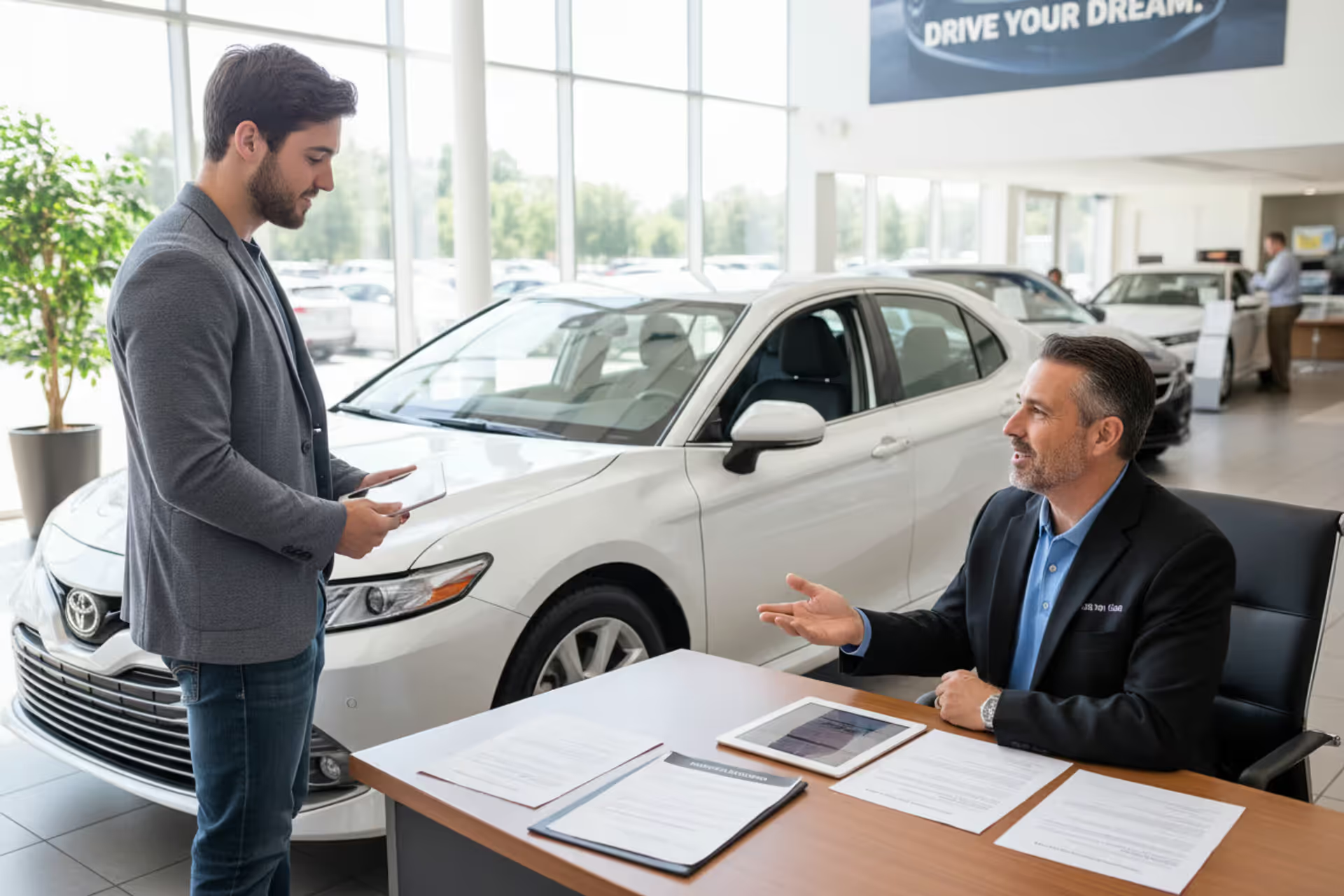
Buyer discussing zero down car financing at a dealership
How to Get a No Down Payment Car Loan

Need wheels now but your bank account is looking pretty empty? You're not alone—thousands of Americans finance vehicles every month without dropping a single dollar upfront. Most lenders would prefer you put some skin in the game, but plenty of financing programs exist for buyers who need to preserve their cash reserves.
Here's the catch: walking into a dealership with no money down doesn't mean this financing comes free. You'll face different challenges than someone making a traditional down payment—higher monthly bills, steeper interest charges, and some financial risks worth understanding before you sign anything.
Let's walk through who actually approves these loans, what you'll pay for the privilege, and whether skipping that down payment makes sense for your wallet.
What Is a No Down Payment Car Loan?
When you finance a vehicle's complete purchase price—every single dollar—you're taking out a zero down payment loan. Nothing comes out of your pocket at signing (well, except for those annoying registration fees and taxes, but we'll get to that).
Compare this to conventional auto financing. Most banks and credit unions want 10-20% upfront. That down payment shrinks the lender's exposure and cuts your monthly obligation. Skip it entirely, and you're borrowing against the vehicle's total sticker price.
Here's what changes when you go the zero down route:
You're financing maximum principal right from the start. Every borrowed dollar costs you interest, so borrowing more means paying more over time.
Lenders see bigger risk in your loan. They often bump up your interest rate to offset that risk—sometimes by a full percentage point or two.
Your car is worth less than you owe the second you drive away. This "upside down" position can last years, trapping you in the loan.
Now, don't confuse a 0 down payment car loan with those flashy "0% APR" promotions dealers advertise. Two completely different animals. Zero down means no cash upfront but you'll still pay interest. Zero percent APR means no interest charges but you might still need money down. Occasionally—during major sales events—manufacturers combine both offers, though these unicorn deals require pristine credit (we're talking 720+ scores) and usually apply to models collecting dust on the lot.
One more thing that trips people up: "nothing down" doesn't equal "nothing out of pocket." You're still paying taxes, title processing, registration, and various dealer fees at closing. In places like California or Texas, expect $1,500-$2,500 in fees on a $25,000 purchase. Some lenders roll these into your loan balance; others demand cash regardless of your down payment situation.

Author: Samantha Whitaker;
Source: ruralxchange.net
Who Qualifies for a Car Loan with No Down Payment?
Lenders scrutinize four major factors before approving anyone for car loan with no down payment financing: your credit track record, income consistency, existing debt load, and job stability. Each piece helps them predict whether you'll actually make payments on this larger loan balance.
Credit Score Minimums by Lender Type
Credit unions and traditional banks typically gate their zero down programs at 680 or higher. These institutions access cheaper capital and maintain strict underwriting standards, so they're picky about who gets 100% financing.
Online lenders and specialized auto finance companies often work with scores ranging from 580 to 680, though you're looking at 9-18% interest rates in this credit tier. These lenders supplement traditional credit scoring with alternative data—your rent payment consistency, utility account history, even banking transaction patterns.
Buy-here-pay-here dealerships might approve you with a 480 score or no credit history whatsoever. But their car loan no down payment offers include brutal terms: interest rates pushing 20-25%, GPS tracking hardware installed on your vehicle, and repossession teams that don't mess around. Example: Someone with a 520 score gets approved for a $15,000 used sedan at 24.9% APR, pays $430 monthly for six years, and ends up paying nearly $16,000 in interest alone.
Manufacturer-backed financing through captive lenders (Ford Credit, Toyota Financial, GM Financial) generally requires 620+ scores for their zero down programs. These work best when you're buying new vehicles from their brand, since they're motivated to clear inventory and can extend competitive rates even without upfront cash.
Income and Employment Requirements
Most lenders want documented gross monthly income at least three times your projected car payment. Eyeing a $400 monthly payment? You'll need proof of $1,200+ monthly income. This calculation ignores your other financial obligations—it's just a starting threshold.
Your debt-to-income ratio (DTI) carries more weight than raw earnings. Take your total monthly debt payments and divide by gross monthly income. Let's say you earn $4,000 monthly and already shell out $1,200 toward student loans, credit cards, and rent. Adding a $450 car payment pushes your DTI to 41%. Most lenders cap DTI around 45-50% for zero down financing, though credit unions sometimes stretch to 55% for members with solid banking relationships.
Employment history requirements vary, but plan on showing two years at your current employer or within the same industry. Recent job switches don't automatically disqualify you if your income jumped or you stayed in your field. A nurse moving between hospitals? No problem. A retail worker who just launched a freelance consulting business? That's a tougher sell for documenting stable income.
Self-employed borrowers face extra scrutiny. Lenders typically average your previous two years of tax returns, which creates problems if you've written off substantial business expenses. A contractor showing $35,000 in adjusted gross income might actually pull $60,000 before deductions, but the lender only sees that lower number on your return.
Where to Find Zero Down Payment Car Loans
Multiple financing sources offer car loan without down payment options. Each comes with distinct advantages and headaches.
Dealership financing programs remain the easiest access point for most buyers. Dealers simultaneously submit your application to multiple lenders—banks, credit companies, captive finance arms. This shotgun approach improves approval odds but generates multiple credit inquiries. Dealers can also mark up interest rates, pocketing commission on the difference between what the lender actually approved and what you accept. Always request the buy rate—the actual rate the lender offered—before signing anything.
Credit unions consistently deliver the most favorable terms for their members, frequently beating bank rates by 1-2 percentage points. Many credit unions serve specific communities, employers, or geographic regions, though membership requirements are often laughably minimal—sometimes just a $5 deposit. Navy Federal, Pentagon Federal, and Alliant Credit Union all promote zero down payment car loan programs for qualified members, with rates starting around 5.5% for borrowers sporting good credit.
Online lenders like Capital One Auto Navigator, LendingTree, and MyAutoloan let you compare offers from your couch. These platforms show you approved rates and amounts before you ever step into a dealership, strengthening your negotiating position. The catch: you'll still finalize paperwork at a dealership, and some dealers resist outside financing because they lose their markup opportunity.
Manufacturer incentives surface most frequently during model-year clearance events (August through October) and holiday sales periods. A Toyota dealer might offer zero down on 2024 Corollas to make room for 2025 inventory. These promotions typically last 30-90 days and apply only to specific trim levels. Read the microscopic print carefully—"zero down" might exclude destination charges, accessories, or extended warranties.
Buy-here-pay-here lots should be your absolute last resort. These dealerships finance their own sales, cutting out third-party lenders entirely. While they'll approve nearly anyone, their business model depends on repossession and resale cycles. Vehicles are typically overpriced, maintenance histories are questionable at best, and the effective APR can exceed 25% even when it's not clearly disclosed due to regulatory loopholes.

Author: Samantha Whitaker;
Source: ruralxchange.net
Pros and Cons of a Car Loan Without Down Payment
Every financing structure involves trade-offs. Zero down arrangements deliver immediate benefits while creating long-term financial pressure.
Immediate ownership without touching your savings ranks as the biggest advantage. Got $3,000 sitting in your emergency fund? Using it for a down payment leaves you vulnerable when unexpected expenses hit. Keeping that cash accessible while still securing reliable transportation can be the smarter play, especially if you're rebuilding finances after a layoff or medical crisis.
Preserving cash for better-return opportunities makes sense in specific scenarios. If you're offered 6% financing with zero down but could invest $5,000 in a business venture or home improvement yielding 12% returns, the math favors keeping your cash working elsewhere. This calculation only holds water if you're disciplined about actually investing the money rather than blowing it on other purchases.
Higher monthly payments are unavoidable when you borrow more. Finance $30,000 at 7% for 60 months and you're looking at $594 monthly. Put $3,000 down on identical terms, and your payment drops to $535—a $59 monthly difference that compounds to $3,540 over the loan's life. That's more than you saved by skipping the down payment entirely.
Negative equity risk starts the moment you sign paperwork and intensifies during the first two years. New vehicles shed 20-30% of their value within 12 months—that's just depreciation reality. Finance $30,000 and your car might be worth $22,000 after one year. If you've only paid down $2,000 in principal, you're $8,000 underwater. This gap traps you in the loan—you can't sell or trade the vehicle without covering the difference in cash.

Author: Samantha Whitaker;
Source: ruralxchange.net
Higher interest rates commonly accompany zero down payment car loans since lenders price in additional risk. A borrower with a 680 score might score 6.5% with 10% down but 8.5% with nothing down. On that $30,000 loan over 60 months, the 2-point rate increase costs roughly $1,600 in additional interest.
Longer loan terms frequently accompany zero down financing as lenders stretch payments to keep them affordable. A 72-month or 84-month loan reduces monthly costs but keeps you paying interest longer and increases the risk you'll owe more than the car's worth for most of the loan period.
How to Apply for a 0 Down Payment Car Loan
A systematic approach improves your approval odds and helps you secure better terms.
Pull your credit reports from Equifax, Experian, and TransUnion through AnnualCreditReport.com before you apply anywhere. Scan for mistakes, paid collections still showing as open balances, or accounts incorrectly flagged as late. Disputing inaccuracies can boost your score 20-30 points within 30 days. If your score hovers near a threshold (679 versus 680, for example), waiting to apply until after a small bump can qualify you for a better rate tier.
Gather documentation before you shop: two recent pay stubs, two years of W-2s or tax returns if self-employed, three months of bank statements, proof of residence (utility bill or lease agreement), and your driver's license. Having everything ready accelerates the process and prevents delays that might cause rate locks to expire.
Secure pre-approval through your bank, credit union, or online lender before visiting dealerships. Pre-approval establishes your baseline—you know you're approved for $25,000 at 7.5%, so any dealer offer should improve on those terms. This knowledge prevents dealers from inflating rates or claiming "that's the best anyone can do" when they haven't actually exhausted their lender network.
Compare offers by examining more than just the monthly payment. Dealers love negotiating on payment alone, obscuring the interest rate and loan term. A dealer offering $425/month sounds better than $450/month until you realize the first quote is 9.5% for 84 months while the second is 6.5% for 60 months. Always compare APR, total interest paid, and loan duration.
Negotiate terms separately: vehicle price first, then trade-in value (if applicable), then financing. Bundling everything together lets dealers shift numbers around, giving you a generous trade-in value but inflating the vehicle price to compensate. Nail down the out-the-door price before you discuss financing options.
Review paperwork in the finance office, where dealers will pitch extended warranties, gap insurance, paint protection, and other add-ons. Gap insurance deserves consideration on a 0 down payment car loan—it covers the difference between what you owe and what insurance pays if your car gets totaled. Most other add-ons are overpriced and negotiable. Take your time reading every document; you're not obligated to sign immediately just because the dealer is rushing you toward the exit.

Author: Samantha Whitaker;
Source: ruralxchange.net
Alternatives to No Down Payment Car Financing
If zero down financing seems too expensive or risky, several alternatives might better fit your circumstances.
Low down payment loans requiring just 5-10% down significantly improve your terms. On a $25,000 vehicle, $2,500 down cuts your loan to $22,500, lowering monthly payments and interest costs while reducing negative equity risk. This middle-ground option keeps more cash in your pocket than a traditional 20% down payment while still providing lender benefits.
Lease options require minimal upfront cash (usually first month's payment plus fees) and offer lower monthly payments than purchase loans. Leasing works if you drive fewer than 12,000 miles annually, want a new car every three years, and don't mind never owning the vehicle. The downside: you're perpetually making payments and have nothing to show for it when the lease ends.

Author: Samantha Whitaker;
Source: ruralxchange.net
Co-signer arrangements let you leverage someone else's credit strength to qualify for better terms. A parent or spouse with a 750 score can help you access rates reserved for prime borrowers, even if your score sits at 620. The co-signer assumes equal responsibility for the debt, though, so missed payments damage both credit profiles. This approach works best for young buyers with limited credit history rather than those with poor payment patterns.
Used car financing reduces the amount you need to borrow and minimizes depreciation concerns. A three-year-old vehicle has already absorbed the steepest depreciation, so negative equity is less severe. Many lenders offer zero down used car loans, though interest rates run 1-2 points higher than new car financing. Target certified pre-owned vehicles from manufacturer programs—they include warranties and have been inspected, reducing mechanical risk.
Building a down payment fund remains the financially optimal choice if you can wait. Three to six months of setting aside $400-500 monthly gives you $1,200-3,000 to put down, dramatically improving your loan terms. Use this time to improve your credit score, research vehicles thoroughly, and wait for seasonal sales events when dealers are most motivated to negotiate.Expert Perspective on Zero Down Financing
Most borrowers completely underestimate how fast negative equity piles up on zero down loans.I've watched clients fall $7,000 upside down just 18 months into their loan, financially trapped because they can't trade or sell without writing a check for the difference. If you absolutely must go with zero down financing, prioritize the shortest loan term you can realistically afford and treat gap insurance as mandatory—not optional. The real danger isn't the higher monthly payment; it's the financial inflexibility that comes from owing substantially more than your collateral is worth
— Jennifer Martinez
Frequently Asked Questions About No Down Payment Car Loans
Securing a no down payment car loan solves an immediate transportation challenge without draining your savings, but this convenience carries measurable costs. Higher monthly obligations, increased interest expenses, and immediate negative equity create financial pressure lasting years.
Whether this makes sense depends entirely on your situation. If you maintain stable income, good credit, and genuine need to preserve cash for emergencies or higher-return opportunities, zero down financing can work. If you're stretching to afford the payment or your credit score sits below 640, waiting to accumulate even a modest down payment substantially improves your financial outcome.
Before committing to any auto loan, calculate the total amount you'll pay over the loan's complete life, not just the monthly payment figure. Compare multiple lenders, scrutinize all paperwork carefully, and never let dealer pressure rush you into unfavorable terms. Your vehicle should provide reliable transportation without creating financial stress—a goal requiring you to balance immediate needs with long-term financial health.
Related Stories

Read more

Read more



The content on this website is provided for informational and educational purposes only. It offers general guidance on topics related to car loans, auto refinancing, interest rates, credit scores, loan terms, and vehicle financing options. The information presented should not be considered financial, legal, or professional advice.
Auto loan terms, interest rates, approval requirements, and refinancing options may vary depending on the lender, credit profile, and individual circumstances.
While we aim to keep the information accurate and up to date, we make no guarantees regarding its completeness or reliability. Visitors should review official loan documents and consult with qualified financial professionals before making decisions related to auto loans or refinancing.