

Young first-time car buyer reviewing documents next to a used car at a dealership
How to Get a Car Loan with No Credit

Starting from scratch with credit can feel like an impossible barrier when you're shopping for your first vehicle. Most of us need a car before we've had the chance to build any borrowing history—maybe you just graduated college, recently moved to the United States, or simply never needed a credit card before now.
Here's what most people don't realize: lenders actually approve thousands of first-time borrowers every single week. The application process looks different than what someone with an established credit file would experience, but rejection isn't inevitable. You'll need to show lenders alternative proof of financial responsibility, understand which institutions actually work with newcomers, and prepare documentation that compensates for your blank credit report.
Can You Get a Car Loan with No Credit?
Getting approved for auto financing without any credit history happens every day across the country. Banks and credit unions have entire departments dedicated to working with first-time borrowers who've never had loans before.
The approval process centers on manual review rather than automated systems. Where established borrowers get instant decisions based on credit scores, you'll have a loan officer actually examine your application—looking at job tenure, bank account stability, and how much cash you've saved. This human element works in your favor when you can demonstrate financial responsibility through non-traditional evidence.

Author: Derek Halvorsen;
Source: ruralxchange.net
Understanding the difference between no credit and damaged credit matters significantly here. Lenders view these situations completely differently. Bad credit means you've borrowed money and handled it poorly—late payments, collections, defaults. No credit simply means you haven't participated in the traditional lending system yet. You're an unknown variable rather than a proven risk. Many institutions would rather work with a blank slate than rehabilitate someone with serious payment problems.
Terms won't match what your friend with a 750 credit score received. Interest rates typically run several points higher, and you might face limits on how much you can borrow initially. Think of these restrictions as temporary training wheels—make payments consistently for twelve months, and refinancing opportunities open up with substantially better rates.
Traditional banks create the biggest hurdle for no-credit applicants. Their underwriting software automatically rejects applications without sufficient credit history. You need to target lenders who've built processes specifically for evaluating first-time borrowers using income documentation, employment verification, and alternative references.
Why Lenders Hesitate with No Credit Applicants
Credit scores exist because they predict future behavior based on past patterns. Someone with a 720 score has statistically proven they repay obligations reliably. When your credit report shows nothing, lenders lose their most important risk-assessment tool.
Think about it from the institution's perspective: they're considering handing you $15,000 with only your promise to pay it back. Without data showing how you've handled previous financial obligations, they're essentially making an educated guess. This uncertainty explains the rate premiums—charging 12% instead of 6% helps offset potential losses from borrowers who might default.
The risk calculation changes dramatically between having no credit versus having poor credit. A 480 credit score tells lenders you've struggled with debt management, missed multiple payments, maybe faced repossession or collections. An empty credit file? That just means you've paid for everything with cash, never needed a loan, or recently established residency in the United States.
We've tracked performance data for years, and first-time borrowers with stable employment actually default less frequently than borrowers with marginal credit scores in the 580-620 range.The real challenge for applicants is proving that stability through documentation that automated systems can't evaluate
— Marcus Chen
Lenders willing to manually review applications focus on three concrete factors: consistent income over time, existing monthly obligations compared to earnings, and cash reserves for down payments. Someone earning $3,200 monthly who's worked the same job for eighteen months and saved $2,800 for a down payment presents minimal risk despite having zero credit history. The problem is finding institutions that take time to examine these details instead of rejecting applications automatically.
Steps to Qualify for a Car Loan with No Credit History
Preparing strategically before you apply makes the difference between approval and rejection. These specific actions address exactly what lenders need to see from first-time borrowers.
Gather Proof of Income and Employment
Lenders base approval primarily on your ability to afford monthly payments. Start by collecting your most recent two or three paychecks showing gross income, taxes withheld, and net deposit amounts. If you receive cash payment or work freelance, you'll need bank statements covering the past six to twelve months that show regular deposits—lenders want to see pattern consistency, not just occasional large payments.
Self-employed applicants face extra scrutiny but can absolutely get approved. You'll need tax returns from the previous two years, preferably showing income growth or at least stability. If your Schedule C shows $42,000 income in 2024 and $45,000 in 2025, that demonstrates upward trajectory that lenders value.
Job tenure carries enormous weight when you lack credit history. Twenty-four months at the same employer signals reliability that partially offsets missing credit data. Changed jobs recently? Prepare a brief written explanation—transferring to a better-paying position in your field looks completely different from bouncing between unrelated industries every few months. Some lenders will call your employer to verify position, start date, and salary, so alert your HR department that they might receive this request.
Calculate your debt-to-income ratio before any lender does. List every monthly payment obligation: rent or mortgage, student loans, existing car payments, credit card minimums if you have any. Add these up, divide by your monthly gross income, and convert to a percentage. Most lenders want this number below 40% for first-time borrowers, though some stretch to 50% when other factors like down payment size are strong. If your ratio exceeds these thresholds, consider paying off some existing debt before applying.
Save for a Larger Down Payment
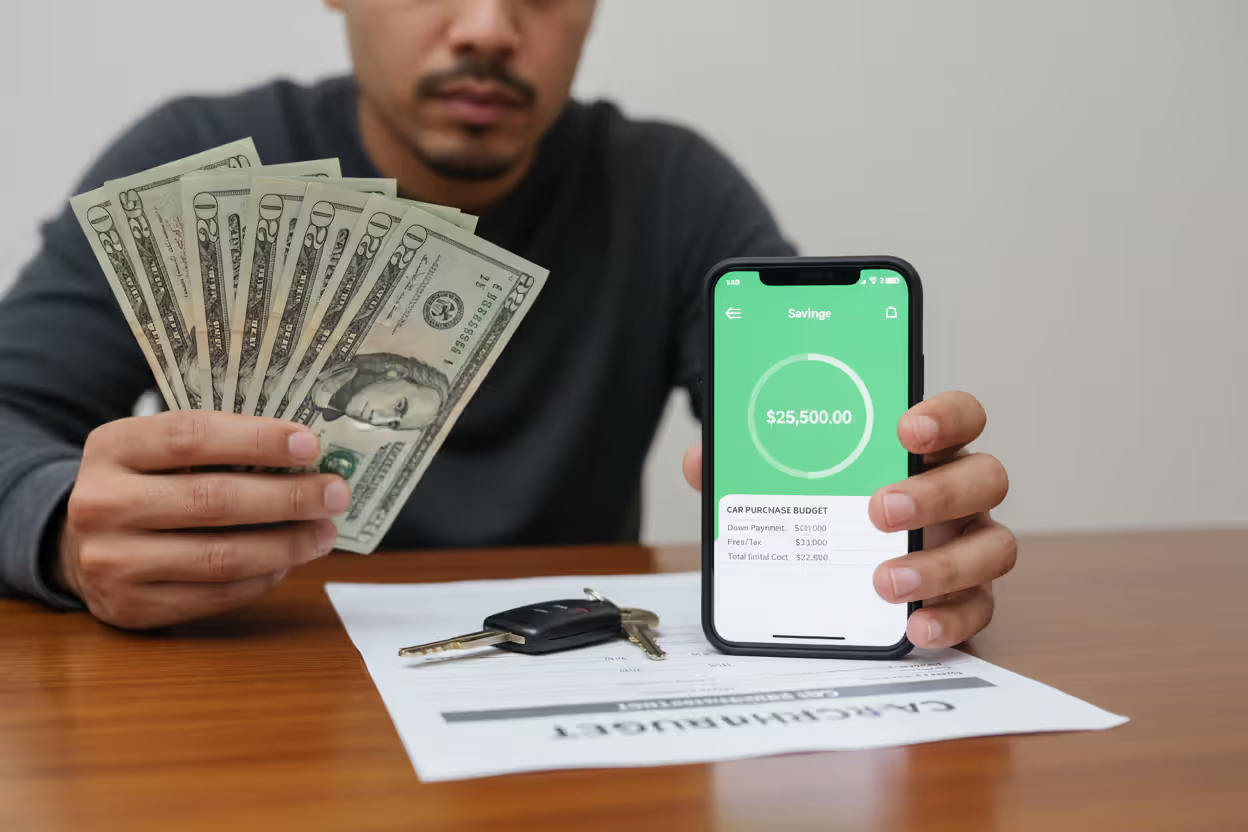
The single most powerful tool for first-time borrowers is a substantial down payment. Aim to save 15-20% of the vehicle's purchase price before you start shopping. Looking at a $14,000 used sedan? That means accumulating $2,100-$2,800 in cash. This amount isn't just reducing what you need to borrow—it's proving to lenders that you can manage money, delay gratification, and plan ahead financially.
Author: Derek Halvorsen;
Source: ruralxchange.net
Down payment size directly influences your interest rate. The gap between putting down 5% versus 20% often translates to 2-3 percentage points on your APR. Over a four-year loan term, that difference adds up to hundreds or even thousands of dollars. More money upfront also protects you from owing more than your car's worth after a year or two of depreciation—a situation that traps many first-time buyers.
Where should this money come from? Personal savings accounts work perfectly. Tax refunds, work bonuses, or monetary gifts from relatives all count. Keep detailed records showing the source of your funds—bank statements, deposit receipts, or signed gift letters from family members. Some lenders require proof that down payment money came from legitimate sources rather than undisclosed loans or credit card advances.
If you currently own a vehicle, trading it in works as a down payment even if it's older or has mechanical issues. A 2012 Honda Accord might only be worth $2,500, but that's $2,500 less you need to finance. Get appraisals from CarMax, Carvana, and local dealers before negotiating—knowing your trade's actual value prevents dealers from lowballing you.
Consider a Co-Signer
Adding a co-signer with established credit transforms your application instantly. They're essentially vouching for you by agreeing to take over payments if you can't, giving lenders the security needed to approve your loan. This single step often converts rejections into approvals and can slash your interest rate by 4-6 percentage points.
Who makes an ideal co-signer? You need someone with a credit score above 670, stable income, and willingness to take on serious financial responsibility. Parents frequently co-sign for their children's first car loans. Siblings, spouses, or close friends with good credit also work, though the arrangement requires significant trust on both sides. Their credit report will list this auto loan exactly as if they'd borrowed the money themselves, and any missed payments hurt their score as severely as yours.
Set clear expectations in writing before moving forward. Document who makes the monthly payment, how you'll communicate about the account status, and what happens if you encounter financial difficulty. Some borrowers set up automatic withdrawals from their checking account and send their co-signer a text confirmation after each payment posts. This transparency maintains the relationship and prevents surprises.
After making twelve to twenty-four consecutive on-time payments, many lenders let you remove the co-signer from your loan. You'll submit an application proving you can now qualify independently based on the positive payment history you've established. This release process frees your co-signer from further obligation and feels like a genuine milestone in your financial journey. Check whether your lender offers this option before finalizing the loan agreement.
Build Alternative Credit References
You've been making regular payments for years—they just haven't been reported to credit bureaus. Collecting documentation of these obligations creates alternative credit references that manual underwriters review when evaluating no-credit applications. Focus on recurring monthly commitments you've maintained reliably over the past twelve months or longer.
Rent payments carry the most weight with lenders. If you've rented an apartment for eighteen months without missing the due date, that's powerful evidence of payment reliability. Request a letter from your landlord on official letterhead confirming your tenancy dates, monthly rent amount, and payment history. Property management companies typically provide these verification letters within a few days of requesting them.

Author: Derek Halvorsen;
Source: ruralxchange.net
Utility accounts—electric, gas, water, internet—show similar responsibility when paid consistently. Contact these providers and request twelve-month payment histories showing your account remains current. Some companies charge small fees ($5-10) for these records, but the documentation strengthens your application meaningfully.
Cell phone contracts, while not traditionally reported to credit bureaus, demonstrate regular obligation management. Request statements covering the past year showing payment dates and amounts. If you've maintained service with Verizon or T-Mobile for three years without late payments, that's relevant data for a loan officer reviewing your file manually.
Several services now report rent payments directly to credit bureaus, creating traditional credit history from your housing payments. LevelCredit, Rental Kharma, and RentTrack charge $5-15 monthly to add your rent to your credit report. Start this process two to three months before applying for auto financing, as bureaus need time to generate scoring data from newly reported accounts.
Where to Apply for a No Credit Car Loan
Your approval odds vary dramatically depending on which type of lender reviews your application. Understanding these differences helps you invest time where success probability runs highest.
| Lender Type | Approval Likelihood | Typical APR Range | Pros | Cons |
| Credit Unions | High | 6-12% | Relationship-focused underwriting, reasonable rates, educational support | Membership requirements, smaller vehicle inventory if buying through them |
| Banks | Low-Medium | 8-15% | Recognizable names, rate matching policies if approved | Automated rejections common, rigid qualification standards |
| Online Lenders | Medium-High | 9-18% | Quick response times, multiple lender connections, soft credit checks | Less personal guidance, rates higher than credit unions |
| Buy-Here-Pay-Here Dealerships | Very High | 15-25%+ | Approve almost everyone, same-day driving | Predatory rates, GPS tracking devices, repossession risk |
| Captive Auto Financing | Medium | 7-14% | Manufacturer incentives, brand loyalty programs | Limited to specific car brands, new vehicle focus |
Credit unions consistently deliver the strongest combination of approval probability and fair interest rates for first-time borrowers. These member-owned cooperatives emphasize relationships over algorithms. Many maintain special programs designed specifically for younger members, recent graduates, or first-time buyers that include financial education components alongside the loan itself.
Joining a credit union is easier than most people realize. Membership requirements might include living within certain counties, working for employers in their network, or belonging to specific organizations—often your eligibility is broader than you'd expect. Some require just $5-25 deposited into a savings account to become a member. Schedule a face-to-face appointment with a loan officer rather than applying online initially. This personal interaction lets you explain your situation and present documentation that automated systems can't evaluate.
Online lending platforms like Carvana, Capital One Auto Navigator, and myAutoloan connect you with multiple lenders simultaneously through a single application. They perform soft credit inquiries that don't affect your credit score, providing preliminary approval decisions within 24-48 hours. Funding typically completes within five to seven business days after final approval. These services excel at casting a wide net quickly, though interest rates usually run higher than credit union offers.
Buy-here-pay-here dealerships approve virtually everyone who walks through the door, but the cost is astronomical. Interest rates frequently exceed 20-22% APR, sometimes reaching 25-29% on older vehicles. These dealers install GPS tracking systems and starter interrupt devices on cars, allowing them to disable your vehicle remotely if payments fall behind. View this option as an absolute last resort after exhausting all other possibilities. The total amount you'll pay over the loan term often doubles or triples the car's actual value.
Captive financing companies—Toyota Financial Services, GM Financial, Ford Credit, Honda Financial—occasionally run first-time buyer programs tied to specific vehicle models. These promotions might offer reduced rates or flexible terms for borrowers without credit history. Timing matters significantly here, as programs appear and disappear based on inventory levels and sales goals. Check manufacturer websites for current offers before visiting dealerships, and remember that these programs typically require purchasing newer vehicles rather than used cars.

Author: Derek Halvorsen;
Source: ruralxchange.net
What to Expect: Rates, Terms, and Loan Amounts
Understanding typical loan structures for first-time borrowers helps you evaluate whether offers you receive are reasonable or exploitative. Interest rates currently range from 8-18% APR for applicants without credit history, with your position in that range depending on factors like down payment size, income level, and whether you include a co-signer.
Context matters when evaluating these rates. Borrowers with excellent credit (scores above 740) currently pay 4-7% APR on average. Those with damaged credit (scores below 600) face 14-20% rates. First-time borrowers occupy the middle ground—higher rates than established borrowers with pristine records, but better than people who've proven they mishanage debt.
Where you land within the 8-18% range depends entirely on application strength. Bring 20% down, show two years at the same job, add a co-signer with good credit? Expect rates toward the lower end around 8-11% APR. Apply with minimal down payment after six months of employment without a co-signer? You'll see offers closer to 14-18%. Each compensating factor improves your rate by roughly 1-3 percentage points.
Loan terms typically span 36-60 months for first-time borrowers. Lenders hesitate extending 72-month or 84-month terms without credit history because longer periods increase default probability substantially. You'll face higher monthly payments with shorter terms, but total interest costs drop dramatically. Consider a $15,000 loan at 12% APR: choosing 36 months means paying $499 monthly with $2,964 in interest charges. Extending to 60 months reduces payments to $334 monthly but increases total interest to $5,040—nearly double the shorter term's cost. If you can afford the higher payment, shorter terms build equity faster and cost less overall.
Borrowing limits for first-time buyers usually cap around $15,000-$25,000 depending on income level. Lenders won't hand you $30,000 for a nearly-new vehicle without established payment history. This ceiling means shopping certified pre-owned or used vehicles rather than brand-new models. Focus on reliable brands 3-5 years old that fit comfortably within lending limits—2019-2021 Honda Civics, Toyota Corollas, Mazda3s, or Hyundai Elantras offer excellent reliability in the $12,000-$18,000 range.
Monthly payment calculations must include full-coverage insurance, which costs significantly more for financed vehicles than liability-only policies. Lenders require comprehensive and collision coverage protecting their collateral until you've paid off the loan. Budget an additional $120-180 monthly for insurance when planning affordability. A $340 car payment becomes $520 total monthly commitment after insurance. Your debt-to-income ratio needs room for both payments.
Pre-qualification tools at most online lenders estimate rates without triggering hard credit inquiries. Run these calculators at four or five different institutions to understand your likely approval range before submitting formal applications. Only apply formally once you've identified your top two or three options—this minimizes hard inquiries on your credit report, which can temporarily lower credit scores by a few points each.
Mistakes to Avoid When Applying
First-time borrowers repeatedly make the same costly errors, but every one is completely avoidable with awareness.
Accepting your first approval without comparing other offers probably ranks as the most expensive mistake. Interest rate differences of 3-5 percentage points between lenders are completely standard. Taking a $15,000 loan over 48 months at 15% APR instead of shopping around and finding 10% costs you roughly $1,200 in unnecessary interest. Apply with at least three institutions within a fourteen-day period—credit bureaus treat multiple auto loan inquiries during this window as a single inquiry for scoring purposes, minimizing credit impact.
Focusing exclusively on monthly payment while ignoring total loan cost creates long-term financial regret. Dealerships manipulate affordable-looking payments by stretching loan terms to absurd lengths. A $24,000 vehicle at 16% over 72 months costs $489 monthly but generates $11,208 in interest charges—nearly half the car's value paid just for borrowing money. Compare that to a $14,000 car at 11% over 48 months: $367 monthly with only $3,616 in interest. The cheaper monthly payment on the expensive car ultimately costs $7,592 more. Always calculate total amount paid over the loan's life, not just the monthly figure.
Visiting dealerships without pre-approval severely weakens your negotiating position. You're essentially asking the dealer to arrange financing without knowing what rate you actually qualify for—giving them maximum opportunity to inflate interest charges and mark up loans. Pre-approval from your credit union or online lender establishes your budget ceiling and provides a competitive rate benchmark. Dealers can't overcharge on financing when you arrive with approved funding already secured. Pre-approval letters remain valid for 30-60 days, giving you plenty of time to shop vehicles confidently.
Ignoring a vehicle's total ownership cost leads to buyer's remorse within months. Your $310 loan payment is just the starting point. Add insurance ($150), fuel ($120-180 depending on commute length and vehicle efficiency), maintenance ($80-100), and registration fees ($60-90 annual average). That $310 payment becomes a $700-810 monthly commitment. Research insurance quotes for specific models before buying—a 2020 Dodge Charger costs dramatically more to insure than a 2020 Honda Accord despite similar purchase prices. Call your insurance agent with VIN numbers before finalizing any vehicle purchase.
Failing to review loan documents line-by-line before signing locks you into terms you might not understand. Read the APR, loan term length, total amount financed, and final payoff amount carefully. Check for prepayment penalties that charge fees for paying off your loan early—these penalties trap you in higher-rate loans when refinancing opportunities emerge. Verify that optional add-ons like extended warranties, paint protection, gap insurance, or theft deterrent systems weren't included without your explicit consent. Dealers routinely slip these into contracts, sometimes adding $2,000-4,000 to your loan balance. You can purchase these items separately later if you actually want them.
Buying more vehicle than you genuinely need strains finances unnecessarily while providing zero transportation benefit. Reliable transportation doesn't require leather seats, sunroofs, or the current model year. A well-maintained 2020 Toyota Corolla with 45,000 miles costs $13,000-15,000 and will run dependably for another eight years. That flashier 2022 BMW with 30,000 miles might cost $28,000 and provide the same point-A-to-point-B transportation while doubling your payment and insurance costs. Choose boring reliability over impressive appearances during your first auto loan—save the luxury vehicles for when you've built credit and increased income.
FAQ
Landing your first auto loan without any credit history requires preparation, but thousands of borrowers successfully complete this process every single week. Focus on demonstrating financial stability through consistent employment, meaningful down payments, and documented payment responsibility in areas like rent and utilities. Target institutions that manually evaluate applications—credit unions and specialized online lenders—rather than traditional banks that automatically reject applicants without credit scores.
Your first auto loan serves dual purposes: providing necessary transportation immediately while building credit history for future opportunities. Select affordable vehicles with payments sitting comfortably within your monthly budget, never miss due dates, and you'll establish the credit profile that seemed impossible to build. After 12-18 months of perfect payments, refinancing opportunities emerge as your credit score develops, potentially saving you thousands in interest through rate reductions.
The mistakes that trap first-time buyers are completely preventable: compare multiple lenders before accepting any offer, read every page of loan documents carefully, focus on total costs rather than monthly payments in isolation, and resist pressure to purchase more vehicle than you genuinely need. Your first car doesn't need to impress anyone—it needs to run reliably, fit your budget easily, and serve as a stepping stone toward stronger financial standing. Approach this strategically, and you'll drive away with both transportation and a solid foundation for building excellent credit over time.
Related Stories

Read more

Read more




The content on this website is provided for informational and educational purposes only. It offers general guidance on topics related to car loans, auto refinancing, interest rates, credit scores, loan terms, and vehicle financing options. The information presented should not be considered financial, legal, or professional advice.
Auto loan terms, interest rates, approval requirements, and refinancing options may vary depending on the lender, credit profile, and individual circumstances.
While we aim to keep the information accurate and up to date, we make no guarantees regarding its completeness or reliability. Visitors should review official loan documents and consult with qualified financial professionals before making decisions related to auto loans or refinancing.