

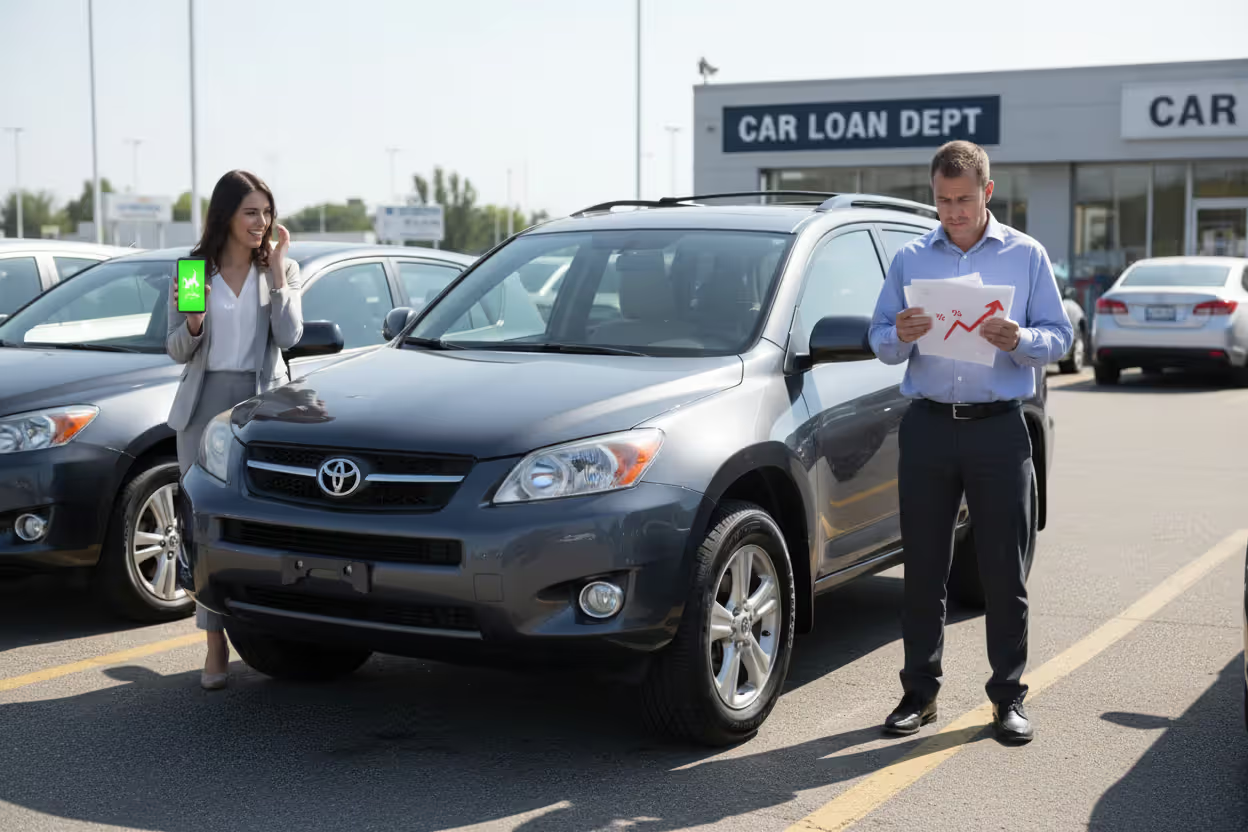
Person reviewing car loan documents at home before applying
How to Get a Car Loan in 6 Steps

My cousin Sarah walked into a dealership last month totally unprepared. Within twenty minutes, their finance guy had her nodding along to an 11.9% interest rate because she had "no idea what her credit looked like" and figured that number sounded reasonable. Her actual credit score? 720. She should've qualified for something around 6.2%. That single decision will cost her an extra $4,800 over the life of her loan.
Here's the reality nobody mentions: the application process itself takes maybe three to five hours spread across a week. You'll gather some documents, fill out forms, review numbers. Not complicated. The expensive part happens when you skip preparation and let someone else control the conversation. In today's market—we're talking spring 2026—borrowers with strong credit profiles lock in rates between 5.5% and 6.5%. Meanwhile, someone with a 590 score might face 13.8% or higher, sometimes topping 16%.
Let's use real numbers. You're financing $28,000 for a used SUV. At 5.9% over sixty months, you'll hand over roughly $3,100 in interest charges. Same vehicle, same timeframe, but at 13.8%? That interest bill climbs to $7,500. You're paying $4,400 extra simply because you didn't understand how this works.
What You Need Before Applying for a Car Loan
Author: Olivia Stratford;
Source: ruralxchange.net
Think of lenders as skeptical business partners. They're asking themselves three questions: Does this person make enough money to handle another monthly obligation? Have they proven they actually pay their bills? If everything goes sideways and we need to repossess this vehicle, how much will we lose? Your job is showing up with answers already prepared.
Credit Score Requirements
Here's where most banks draw their line: anything below 620 gets rejected or routed to subprime divisions charging premium rates. Cross the 740 mark, though, and suddenly you're in their preferred tier—rates drop by two full percentage points, sometimes more. I pulled my credit reports from Equifax, Experian, and TransUnion about six weeks before I started shopping for my current vehicle. Good thing I did. Experian showed a medical collection for $280 that I'd already paid eighteen months earlier. Filing that dispute consumed nearly forty days, but it bumped my score up 32 points.
One in five credit reports contains mistakes serious enough to impact lending approvals, according to Federal Trade Commission research. Checking costs you nothing at annualcreditreport.com. Fixing errors after you've already applied? That's when things get messy.
Income Verification
Lenders calculate something called your debt-to-income ratio—essentially, they add up all your monthly debt payments (existing car loans, student loans, credit cards, mortgage) and divide by your gross monthly income. They want that percentage staying under 43%, though certain lenders push it to 45% if everything else looks solid. Gather your last two months of pay stubs, your most recent W-2 forms from the past two years, and bank statements proving regular deposits.
Self-employed? Welcome to documentation hell. You'll need complete tax returns covering two full years, current profit-and-loss statements, possibly a letter from your accountant verifying income. Some lenders want business bank account statements going back twelve months. They're not being difficult—they're trying to confirm your income is stable when you don't have an employer issuing predictable paychecks.
Down Payment Expectations
Nobody forces you to put money down. Plenty of lenders write 100% financing deals. But here's what actually happens: they compensate for increased risk by bumping your interest rate half a point, sometimes a full point. Drop 10-12% on a new vehicle, or 18-20% on something used, and watch better rates materialize. You're also protecting yourself against depreciation. New cars shed about 22% of their value during year one. Starting with equity means you won't immediately owe $22,000 on something worth $18,500.
Required Documents
Build this folder before you submit a single application: current driver's license, proof of insurance or a letter from your insurance agent confirming they'll cover the new vehicle, recent utility bill or lease agreement proving where you live, complete trade-in details if you're trading something in (registration, title, payoff information if you're still financing it), and contact information for three personal references. Having everything organized prevents those frustrating delays where your approval expires because you spent four days tracking down proof of residence.

Author: Olivia Stratford;
Source: ruralxchange.net
Where to Apply for a Car Loan
Each lending category operates under different priorities. Your best match depends on your credit situation, how quickly you need an answer, and whether you're willing to negotiate.
Banks typically reward existing customers with rate discounts—sometimes a quarter point, occasionally half a point if you maintain multiple accounts with them. Processing moves faster since they already have your banking history on file. The problem: their underwriting departments follow rigid guidelines. Limited credit history or recent financial problems trigger automatic rejections, no exceptions, no human review.
Credit unions consistently deliver the lowest rates in the market. I'm talking 4.7% when everyone else starts at 5.9%. They're structured as nonprofit cooperatives owned by their members, so they're not optimizing for shareholder returns. The catch: you need membership eligibility. Some credit unions serve specific employers. Others open membership to anyone living in certain counties. A few let you join by making a small donation to a partner nonprofit. Credit unions also employ actual underwriters who examine circumstances beyond just your credit score.
Online lenders prioritize convenience and speed. Upload your documents at midnight, receive a decision by morning, get funded within 48 hours. The tradeoff: their algorithms can't negotiate, and certain online operations charge rates a full percentage point higher than traditional lenders to offset the risk of lending to strangers they'll never meet face-to-face.
Dealership financing bundles everything into one stop. Dealers maintain relationships with dozens of lenders—sometimes they'll push through an approval you couldn't secure independently. Here's the problem that costs consumers billions annually: dealers mark up your rate to earn commission. You actually qualify at 6.1%, but their finance manager quotes you 7.6% and pockets the spread. Always arrive with outside pre-approval already secured. It's your only leverage.
| Lending Source | Rate Range You'll Actually See | How Long Until You Know | Credit Score Floor | Real Advantages | What They Won't Tell You |
| National Banks | 5.5% to 10.8% | One to three business days | 680 minimum, exceptions rare | Relationship discounts if you're already a customer, instant access to funds | Strict underwriting leaves no room for special circumstances |
| Credit Unions | 4.7% to 9.2% | One to four business days | 615 minimum, case-by-case below that | Lowest market rates by significant margins, humans review your application | Membership requirements eliminate many applicants |
| Online Platforms | 5.9% to 14.2% | Same day to 48 hours | 580 minimum at specialized subprime lenders | Approve applications at 2am, fully remote process | Rates run higher on average, zero negotiation flexibility |
| Dealer Finance Departments | 6.8% to 19.5% | Same-day approval common | Varies wildly by lender network | One-stop convenience, access to manufacturer promotional rates | Rate markups hidden in paperwork, high-pressure sales environment |
How to Apply for a Car Loan Online
Set aside twenty to forty minutes per application. You'll input personal identification details, employment information, monthly housing costs, and how much you want to borrow. Most platforms respond within fifteen minutes for straightforward situations. Complicated finances—you're self-employed, you've got recent credit problems, your income fluctuates seasonally—might trigger a phone call from an underwriter requesting clarification.
Here's something most people miss: use incognito mode or clear your cookies between lender websites. Certain platforms adjust their offers based on your browsing behavior and how desperate you seem. Compress all your applications into a fourteen-day window maximum. Credit scoring algorithms treat clustered auto loan inquiries within that timeframe as a single event, preventing score damage from repeated checks.
Applying Through a Dealership vs. Direct Lender
Direct lenders show you the actual rate with zero markup. Dealerships insert themselves as profitable middlemen. Walk in with solid credit and pre-approval from your credit union at 5.7%, and suddenly you've got leverage when their finance office quotes 7.4%. They'll frequently match or beat outside offers rather than lose the financing commission entirely—they earn nothing if you arrange financing elsewhere.
Never mention you're paying cash until after you've negotiated the vehicle's purchase price. Dealers often discount vehicles more aggressively when they're anticipating profit from financing, then quietly raise the price once you announce you're writing a check. Negotiate what you're paying for the vehicle first, as a completely separate transaction. Introduce your pre-approval only after that number is finalized.

Author: Olivia Stratford;
Source: ruralxchange.net
Step-by-Step Car Loan Application Process
Step 1: Check Your Credit
Download reports from all three major bureaus through annualcreditreport.com. Scan for errors, overlooked late payments from five years ago, old collection accounts you thought were resolved. FICO Auto Scores weigh factors differently than standard credit scores—they emphasize your history with past auto loans while minimizing credit card utilization. Spot something inaccurate? File disputes immediately. Resolution typically stretches 35 to 50 days, sometimes longer if the creditor doesn't respond promptly.
Step 2: Get Pre-Approved
Pre-approval delivers actual numbers instead of vague estimates. Target three to six lenders during a two-week window. Pre-approvals stay valid anywhere from 30 to 60 days and carry zero obligation to borrow. You'll receive a maximum loan amount and guaranteed interest rate, so you understand exactly what you can afford before you fall in love with something stretching your budget.
Step 3: Shop Rates
Focus exclusively on annual percentage rate, never monthly payment. Dealers manipulate monthly payments by extending loans to 72 or 84 months, but you'll hemorrhage money through compounding interest charges. Calculate this every single time: multiply your monthly payment by the total number of payments, then subtract the amount you borrowed. Whatever remains represents your true borrowing cost.

Author: Olivia Stratford;
Source: ruralxchange.net
Step 4: Submit Your Application
Once you've identified your best rate, complete the formal application. This triggers a hard credit inquiry, temporarily dinging your score by a few points. Provide accurate information down to the exact dollar—misrepresenting income or employment leads to instant denial or, worse, loan cancellation after funding when their verification process uncovers the deception.
Step 5: Review Terms
Read every single page of that loan contract before you sign anything. Confirm the APR matches what they initially quoted. Look for prepayment penalties—they're uncommon these days but still exist at certain lenders. Verify the loan term matches what you agreed to. Watch for add-ons you never requested: extended warranties, GAP insurance, prepaid maintenance packages that silently inflate your loan balance by $2,500 or more. These products deliver value in specific situations, but they should be intentional purchases, not surprises you discover ninety days later when reviewing your loan statement.
Step 6: Finalize the Loan
The lender wires payment directly to the seller or dealership. You'll receive either physical payment coupons mailed to your address or online account credentials for electronic payments. Set up automatic payments immediately—late fees typically run $25 to $50, and lenders report delinquencies to credit bureaus once you hit thirty days past due. Your first payment generally comes due between 30 and 45 days after contract signing, depending on the lender's billing cycle.
How to Get Approved for a Car Loan with Bad Credit
Bad credit narrows your options without eliminating them. Subprime lenders build entire businesses around higher-risk borrowers. You'll simply pay elevated rates for access to capital.
Increase Your Down Payment
Put down 22-28% upfront, and you reduce the lender's exposure while demonstrating serious financial commitment. Borrowing $18,000 instead of $24,000 on identical vehicles means substantially less money at risk if you default. Some borrowers with scores in the 560-590 range get approved exclusively because they contributed 30% or more as down payment. You're essentially buying your way into approval by reducing the lender's risk.
Add a Co-Signer
A co-signer with solid credit essentially stakes their financial reputation on your reliability. They become equally liable for repayment—miss a single payment, and their credit suffers identically to yours. The lender can pursue them for the entire outstanding balance if you disappear. This isn't a casual favor. Only ask someone who fully understands they're assuming genuine financial risk, and make absolutely certain you can handle payments before involving someone else in your obligation. My brother co-signed for his girlfriend's car loan three years ago. They broke up, she stopped paying, and he's still dealing with the credit damage.

Author: Olivia Stratford;
Source: ruralxchange.net
Choose an Older or Less Expensive Vehicle
Lenders approve smaller loans more readily. A $14,000 loan on a four-year-old sedan faces substantially less resistance than a $36,000 loan on a brand-new truck, even with identical down payment percentages. Older vehicles also carry lower insurance premiums, reducing your total monthly transportation expenses and making the entire arrangement more sustainable long-term.
Consider Credit-Builder Loans First
If you've got time before you absolutely need transportation, a credit-builder loan can boost your score 35-55 points across six to twelve months. You borrow something modest like $600 or $1,200, which the lender holds in a savings account while you make monthly payments. After complete repayment, they release the funds to you, and you've established positive payment history. Credit unions offer these with minimal fees—sometimes no fees whatsoever.
Common Car Loan Application Mistakes to Avoid
Not Shopping Around
The first offer rarely represents your best option. Accepting it without comparison costs real money—potentially $2,800 to $4,500 compounded across the loan's full term. Rate shopping feels tedious when you'd rather finalize the purchase and drive away, but the return on three hours of effort can exceed $150 per hour in genuine savings.
Applying Too Many Times
Multiple applications compressed into a narrow window count as one inquiry, protecting your credit score. Spread those applications across three or four months, though, and you're accumulating separate hits. Your score drops five to eight points with every hard pull. Complete all shopping within fourteen days maximum, then stop applying.
Ignoring the Total Cost
Monthly payment hypnosis is real. A dealer shows you that $415 fits comfortably in your budget, and you stop considering that you're paying $415 for 84 months—$34,860 total on a vehicle with a $26,500 sticker price. Calculate total interest paid, every single time. That's the only number that reveals true borrowing cost.
Skipping Pre-Approval
Walking into a dealership without pre-approval surrenders all negotiating leverage to their finance office. You can't evaluate whether their "incredible rate" actually competes with market rates, and you're vulnerable to every pressure technique they've refined over decades. Pre-approval consumes roughly sixty to ninety minutes and potentially saves years of financial regret.
Borrowing for Too Long
Loans exceeding sixty months frequently trap you underwater—owing more than the vehicle's worth. Need 72 or 84 months to afford the monthly payment? You're buying too much car. Owing more than the vehicle's current value creates nightmares when you want to sell or trade. You'll need to cover the difference from your pocket or roll negative equity into your next loan, compounding the problem indefinitely.
Overlooking Loan Fees
Origination fees, documentation charges, and processing costs accumulate faster than expected. A $450 origination fee seems insignificant on a $23,000 loan, but you pay interest on that fee throughout the entire loan duration. A 6.8% APR on that $450 adds an extra $85-plus to your total cost across five years. Multiply that across multiple fees, and suddenly you're looking at an extra $400 in total interest charges.
Understanding Your Car Loan Offer
Annual Percentage Rate (APR)
This represents your actual borrowing cost, bundling together interest and most mandatory fees into one percentage. An APR of 6.2% means you're paying 6.2% annually on whatever principal balance remains. APR makes comparison straightforward—lower APR equals less money leaving your pocket.
Loan Term
The number of months you'll make payments. Standard terms span three to six years, sometimes seven years on expensive vehicles. Shorter terms force higher monthly payments but slash total interest dramatically. Borrow $23,000 at 6.8%, and you'll pay $2,180 in interest across four years versus $4,380 across six years. Same loan, same rate, double the interest cost.
Monthly Payment
Principal plus interest divided across your borrowing period. This number needs to fit comfortably alongside insurance, fuel, maintenance, registration costs, and parking if you're in a city. A useful guideline: keep total vehicle expenses under 18% of your gross monthly income. Stretch beyond that, and you're squeezing your budget dangerously tight.
Total Interest
Take your monthly payment, multiply by the number of payments, then subtract the original loan amount. That's what borrowing costs you in real dollars. With identical loan amounts and interest rates, longer terms always mean paying substantially more total interest because you're carrying the balance for additional months while interest compounds.
Fees and Add-Ons
Scrutinize every line item on that contract. Legitimate fees include documentation charges—typically $125 to $350—and occasionally loan origination fees, usually capped at 1-2% of borrowed amount. Question everything else aggressively. Paint protection, fabric treatment, VIN etching, nitrogen tire fills—these are dealer profit centers marked up 400-600% above actual cost. Want these services? Purchase them elsewhere for a fraction of the price. I watched a dealer try to charge my neighbor $800 for paint protection that costs $60 wholesale.
The biggest mistake I see is buyers focusing exclusively on monthly payment. Dealers know this and stretch loans to hit a payment number, but that's how you end up paying $38,000 for a $30,000 car. Always look at APR and total interest—those numbers tell you what you're really paying
— Jennifer Marks
Frequently Asked Questions
Getting a car loan distills down to preparation and aggressive comparison shopping. Pull your credit reports early—like six weeks before you plan to buy—assemble your documents in one folder, and fire off applications to multiple lenders within a tight timeframe. Understand what you're actually signing—the APR, total cost, and loan term matter infinitely more than the monthly payment in isolation. Dodge common traps like extended terms and dealer markups by showing up armed with pre-approval from an outside lender.
The entire process consumes maybe four to six hours of focused attention spread across a week or two, but those hours can save you anywhere from $2,500 to $5,000 in total interest charges. Rates swing wildly between lenders—sometimes by two full percentage points—and the gap between a smart loan and a mediocre one compounds relentlessly over time. Whether you're financing something new or used, whether your credit shines or needs work, the fundamental steps stay consistent: understand your numbers thoroughly, comparison-shop aggressively across at least four lenders, and read every line of every document before you sign. Your future self will either thank you when you're making that final payment with money to spare, or you'll be kicking yourself for skipping these steps and bleeding an extra hundred dollars monthly for six years straight.
Related Stories

Read more

Read more




The content on this website is provided for informational and educational purposes only. It offers general guidance on topics related to car loans, auto refinancing, interest rates, credit scores, loan terms, and vehicle financing options. The information presented should not be considered financial, legal, or professional advice.
Auto loan terms, interest rates, approval requirements, and refinancing options may vary depending on the lender, credit profile, and individual circumstances.
While we aim to keep the information accurate and up to date, we make no guarantees regarding its completeness or reliability. Visitors should review official loan documents and consult with qualified financial professionals before making decisions related to auto loans or refinancing.